Tag Archives: complexity

Complexity & Management Conference 6-8th June 2025

Transformative possibilities in the everyday – habit, affect and the unconscious

I was recently in a training being inducted into a new leadership programme. The course facilitators placed a heavy emphasis on bringing about changed ‘behaviours’ in those who were to study on the programme. Implicit in this focus is the idea that we know in advance what leaderly activity looks like. Additionally, the use of the plural ‘behaviours’, carries a false precision. The idea, I suppose, is that these ‘behaviours’ are identifiable and measurable, contributing to ‘evidence’ that someone has learned the leadership skills that are required, and can bring about the expected  ‘transformation’.

This programme is not at all unusual in having designs on our habitual conduct. Our family groups, the organisations we work for, the societies we live in all shape our every day behaviour, our habitual ways of dealing with each other, and may have aspirations for shaping them further: to make us conform, to make us cohere with others, to behave respectfully, to help groups work, to encourage us to spend more and commit more. While our socialisation may take  place largely prereflectively and unconsciously, in advanced capitalist economies there are algorithms, marketing and advertising disciplines which deliberately seek to direct our everyday actions towards certain ends. We live in an economy of persuasion. To what extent do we notice and become mindful of the ways in which our habits are shaped and how try to shape others?

From a pragmatic perspective, concentrating on the actions of one individual, whether they are in a leadership position or not, leaves out a great deal. For example, the leader may propose, but how does everyone else respond? Until we take the gesture and the response together we cannot begin to understand what an action means. And what kind of feelings are evoked in the exchange? To what degree are the habitual patterns of relating affected by the leader’s ‘behaviours’ as opposed to the broader game of games which is taking place in the organisation and beyond? How does the unconscious manifest in group dynamics, particularly if the group is anxious and uncertain? To what degree do context, time and artefacts make a difference?

While organisations tend to have grand schemes of wholesale transformation, change is a complex and uncertain undertaking.  From a complexity perspective, whatever we take transformation to be it is just as likely to arise from the micro, the minor gesture, the adjustments of habit in the every day following a break down, which can escalate into population-wide change.

At next year’s conference we are delighted to have Carolyn Pedwell, Professor of Digital Media in the Sociology Department at Lancaster University,  as key note speaker to explore these themes with us. Amongst Carolyn’s publications is her book Revolutionary Routines: The Habits of Social Transformation (McGill-Queens UP, 2021), which explores the paradoxical quality of habits, which enact the possibility of continuity and change both at the same time.

The conference begins on Friday 6th June 2025 and finishes at lunchtime on Sunday 8th. The currency of the conference is conversation and exploration in large groups and small.

I will put up a payment site in the New Year. Look forward to seeing you there.

Complexity and Management Conference 7th-9th June 2024

Complexity and the emergence of culture

The concept of culture in organisations is widely used but often poorly understood. So how do group identities and a sense of belonging emerge, and what methods might we employ to understand them better? How might we do justice to the contradictions and tensions that are constant themes shaping the experience of group life? 

Working with the intersection of symbolism, politics and culture, Professor Candida Yates will talk about a current research project where she is trying to understand how the community imaginary is developed and sustained. Drawing on work she is undertaking with a community on the south coast of the UK, Professor Yates will give examples of art-based and psycho-social approaches to exploring to the emergence of meaning in a UK maritime community through the exploration of thoughts, feelings, politics and experience.

Candida Yates is Professor of Culture and Communication, Bournemouth University. She is an interdisciplinary scholar and applies a psychosocial approach to culture, politics and society and has published widely in that field. She works with academics, clinicians, creatives and cultural organisations to create new understandings of emotion and affect in the public sphere. She is a Co-Director of the BU Centre for the Study of Conflict, Emotion and Social Justice and sits on the Executive Boards of the Association for Psychosocial Studies; is a Founding Scholar of the British Psychoanalytic Council and is an Academic Research Associate of the Freud Museum. She is Joint-Editor of the Routledge book series: Psychoanalysis and Popular Culture, and is a Contributing Editor on the journals Psychoanalysis, Culture and Society, and The Journal of Psychosocial Studies.

The annual Complexity and Management Conference is intended as an antidote to the sense of drift and thoughtlessness which can afflict managers in organisations because of the sheer complexity and pace of work, and the abstractions of contemporary management discourse. The currency of the conference is conversation, reflection and meaning-making about things that matter to us in and beyond the workplace.

Beginning with an inaugural dinner in the evening of Friday 7th of June, the formal conference will start on Saturday morning with Prof Yates’ thought-provoking key note to encourage the movement of thinking. Thereafter it is reflection and reflexivity continuously till lunchtime Sunday on topics brought by the conference participants themselves.

The conference promises good food, stimulating conversation, and a chance to rediscover oneself in one’s work.

Booking for the conference will begin in the New Year 2024. Next year’s conference will be held in association with the KIOL Executive Leadership programme in Denmark.

Hope to see you there.

Complexity and Management Conference 7-9th June 2024

Finding ourselves in our work

In the last few weeks, three people I have been corresponding with have suggested that we might ‘jump on a call’. When I asked one of them what he thought it signified, he replied that he spent so much time at work jumping from one thing to the next that the expression denoted a state of mind, a way of summing up what work feels like. 

When I work with groups of managers they tell me similar things, that they are obliged to rush around ‘delivering’ things without a moment’s thought. They are caught up in the game of every day organisational life, consumed by obligations to the plan, the target or the performance indicator. While it’s great to be busy, being so overwhelmed with ‘feeding the beast’ may lead to feelings of alienation and meaninglessness. Contemporary management offers any number of tools, techniques and recipes which deal in abstractions, where people and what they are saying and doing can disappear from view. If we wanted better to find ourselves in our work with colleagues, we wouldn’t necessarily start there.

The annual Complexity and Management Conference is intended as an antidote to the sense of drift and thoughtlessness which can afflict managers in organisations because of the sheer complexity and pace of work, and the abstractions of contemporary management discourse. The currency of the conference is conversation, reflection and meaning-making about things that matter to us in and beyond the workplace.

Beginning with an inaugural dinner in the evening of Friday 7th of June, the formal conference will start on Saturday morning with a thought-provoking key note to encourage the movement of thinking. Thereafter it is reflection and reflexivity continuously till lunchtime Sunday on topics brought by the conference participants themselves.

The conference promises good food, stimulating conversation, and a chance to rediscover oneself in one’s work.

Booking for the conference will begin in the New Year 2024.

Hope to see you there.

Complexity and Management Conference 2-4th June 2023.

Complexity, uncertainty, breakdown: coping, recovering and finding hope in dark times.

With the world in flux, perhaps it’s time to be less naïve about the idea of disruption. Our recent experience tells us that we have struggled to respond to disruptive socio-economic and political forces, let alone harness them for the good. Instead constant upheaval on the grand scale, the banking crisis, the pandemic, political and economic instability, has permeated society and our psyches, and has shown up inevitably in our practices and relationships in everyday organisational life. The effects of political and social turmoil, economic collapse, have set constraints on what we can achieve together in organisations. And they may have produced acute and enduring work place dilemmas which can provoke anxiety, burn-out and a sense of hopelessness. Constant disruption demands a more creative and subtle approach than may be found in orthodox recipes for leading, managing and consulting, or an idealisation of its benefits. Equally, we are required to find more generative responses than those offered by the lords of misrule who come to prominence in dark times recommending simplistic solutions to complex problems.

It is also worth thinking about the possible benefits of the huge disruption to traditional working practices caused by what the Oxford English dictionary now recognises as a neologism: the permacrisis. No profound set of social and economic changes is an unalloyed disaster. Where are the loci of hope?

The Complexity and Management Conference 2023 will address what can feel like a constant state of breakdown, potentially undermining things we may previously have taken for granted, such as plans, rules, loyalties, markets, knowledge, and how we exercise authority in groups.

The conference will be organised around contributors to the recent Complexity and Management series published by Routledge, which include the titles Complexity and ConsultancyComplexity and Leadership and Complexity and the Public Sector. Contributors will talk about their experience of leading, managing and consulting to a wide range of organisations, particularly the public sector. An invitation is also extended to all delegates attending the conference who want to offer a workshop on Saturday afternoon 3rd June.

If you are interested in the difference it makes to take the complex interplay of relationships seriously, particularly in dark times, then book for the 2023 Complexity and Management Conference, 2nd-4th June. The conference is highly discussive and conversation is the currency of participation. It will greatly enhance the conference if delegates bring concrete examples of their workplace dilemmas.

The conference is organised in collaboration with KIOL Executive Programme at University College Copenhagen.

The booking site will go up in the New Year.

Ralph Stacey Memorial Lecture 5/10/22

The following is the text of the Ralph Stacey Memorial Lecture which I gave at Hertfordshire Business School on Weds 5th October 2022. It accompanies the video which you will find in the post below.

The response to the lecture was give by Patricia Shaw, who co-founded the Doctor of Management programme with Ralph and the late Doug Griffin.

Continue reading

The Doctor of Management programme

At the heart of the community of inquiry developing the perspective of complex responsive processes of relating is the Doctor of Management (DMan) programme. It has been running for more than 20 years and to date has produced 75 doctoral graduates. In the pragmatic tradition we encourage students to take their every day experience seriously, and to think sociologically about how their daily travails are informed by, and inform broader socio-economic trends. They are encouraged to take the perspective of the pilot, and at the same time the perspective of the swimmer, caught up along with everyone else amid the swirling currents of every day organisational life. If the theses graduates produce have one thing in common, it is that they are all extended exercises in reflexivity. We encourage managers and consultants to think about how they are thinking and acting with others, and to bring their assumptions about the world more the fore. In doing so they are complexifying experience, but when they do so they are still obliged so say something of relevance and interest to colleagues working in similar domains. They produce knowledge from practice for practice.

If this video makes you interested in the DMan, the conference, or anything else, then please get in touch. The book is available here: https://amzn.to/3GIZYFj . Many thanks to David O’Dwyer  for making this video.

Developing thinking, developing the practice of complexity

More publications are in press following the publication of my book last November. Nick Sarra and Karina Solsø have edited a volume on complexity and consultancy; Kiran Chauhan and Emma Crewe have edited a volume on complexity and leadership, and Karen Norman and I are editing one on complexity and the public sector. More information on their publication dates soon.

Meanwhile Davide Nicolini will be our key note speaker at this year’s conference 3-5th June entitled The Theory of Practice and the Practice of Theory. You can book for the conference here.

If this video makes you interested in the part time professional doctorate the DMan, which is run psychodynamically, the conference, or anything else, then please get in touch. The book is available here: https://amzn.to/3GIZYFj . Many thanks to David O’Dwyer of https://lnkd.in/edgdxwgA for making this video.

What do managers do from a complexity perspective?

Online book launch – 6-7pm UK time Tues Nov 30th 2021

If you’d like to pop in for just an hour to hear about the new book, to meet others interested in complexity, to meet old friends and perhaps some new ones,  and to celebrate the legacy that Ralph Stacey has left us, then write to me at c.mowles@herts.ac.uk and I’ll send you a link 24 hours ahead of the launch.

Complexity – a key idea for business and society

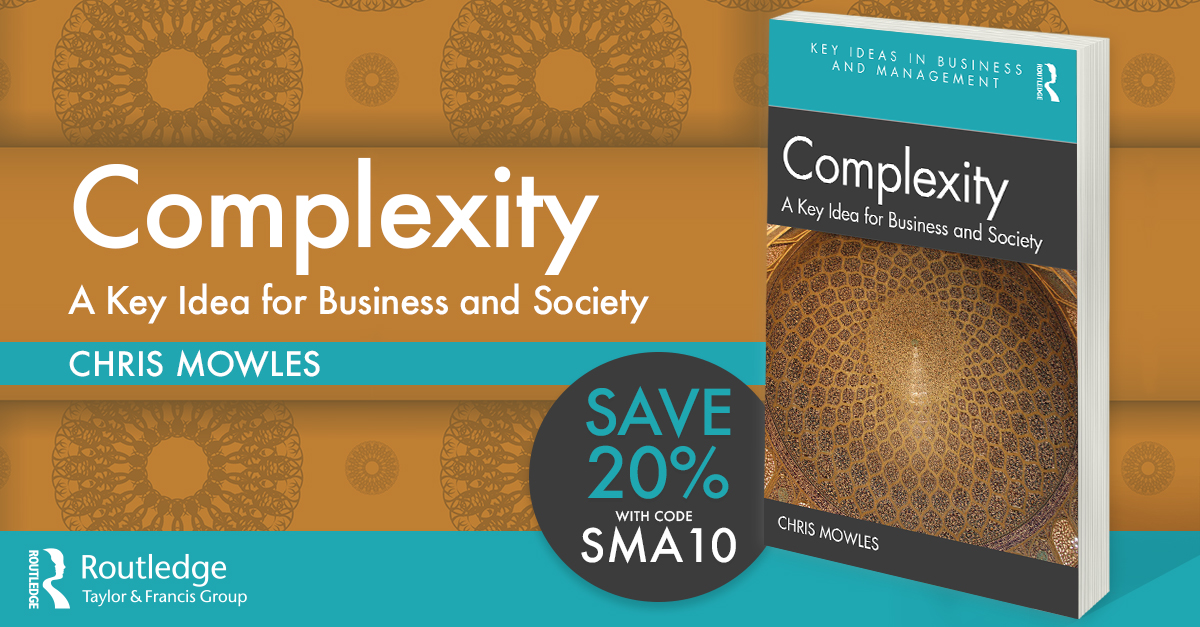
Coming out at the end of November and turning on 7 types of complexity: thoughts about complex selves, complex action, complex knowledge, complex communication, complex authority and complex ethics, all arising from complex models. A plea for management humility along the way.

Complexity and Management Conference 4-6th June 2021 – booking now.

The Complexity and Management Conference 4-6th June 2021 – The Complexity of Practice, is open for booking now. Here is the booking page.

This year we are delighted to have Professor Hari Tsoukas, who is well known to many of you,  as our key note speaker. Hari is Columbia Ship Management Professor of Strategic Management at the University of Cyprus and Distinguished Research Environment Professor of Organization Studies at Warwick Business School. He is best known for his contributions to understanding organizations as knowledge and learning systems, for re-viewing organizational phenomena through the lens of process philosophy, for exploring practical reason in organizational contexts as well as the epistemology of reflective practice in management, and for bringing insights from Aristotelian, Wittgensteinian and Heideggerian philosophy to organization and management studies.

The staging of this year’s conference is no less an uncertain undertaking than last year’s. So we are organising for a face to face event, but at the same time preparing to go online. This means that the booking page requires you to make two payments. The first is a deposit (£100), and the second (£700) is to top up the payment to the full conference fee amount (£800). Should the face to face event be cancelled and we move online, we will refund you the top-up amount (£700) and keep the deposit as payment for the online event. This is the way the university best copes with refunds and it will save you going through the whole process again.

The event will, as usual, be highly participative and deliberative. If face to face, the conference begins on the evening of Friday 4th June with complementary drinks and gala dinner, and ends after lunch on Sunday 6th June. The conference fee covers all board and lodging for the event at Roffey Park Institute, Horsham UK. If we move online the conference will be just Saturday 5th June from 9am till 5.30pm.

There are limited places, so book early to avoid disappointment. I will send out an agenda early May once it is clear what kind of event we will be staging.

Whether face to face or online, the afternoon of Saturday 5th will comprise seminars presented by conference delegates emerging from some aspect of their work related to the conference theme on which they would like to convene a discussion. If you would like to convene such a seminar, please contact me.

On Friday 4th June, whether face to face or online, there is an introductory workshop to the ideas which inform the Doctor of Management (DMan) programme, a perspective we term complex responsive processes of relating. The workshop too will be very participative and discussive, drawing on delegates’ every day experience at work.

Looking forward to seeing you there, one way or another.