Tag Archives: complex responsive processes

Complexity and Management Conference 3-5th June 2022 – booking now.

The theory of practice and the practice of theory

When people sit together to talk about what’s going on, how they experience work, how they feel about their jobs, there may be some colleagues who complain that this is ‘just a luxury’. There is no time to sit around in a ‘talking shop’ when there is so much to do. And anyway, post-pandemic, haven’t we learnt that we can achieve just as much online?

If you are of the view that sitting around talking and thinking about how we are thinking and talking, what we find ourselves doing at work, then this year’s Complexity and Management Conference is probably not for you. As a broader research community we make an explicit assumption that one of a manager’s key tasks is to talk with their team about what they think is going on, what sense they make of it, and what it means for the group in taking the next steps together.

As a partial answer to the second point, why we are not running it online, we have organised this conference for the past two years online, and have benefitted from a broad range of participation from delegates who live too far away to come. From across time zones and sometimes great distances they have enriched the experience of paying attention to what we are doing. But it’s also the case that some qualities get lost. If we are concerned not just to talk about ideas, but to experience them, then occasionally there is no substitute for getting bodies together in a room. No more so when we choose to talk about the paradox of theory and practice. There is a practice in talking about theory, and the experience of doing so enhances learning in ways which are more than cognitive. We are moved into a different relationship with others and ourselves, a process which is attenuated online. Maybe everyone has recently experienced the difference of coming back to the workplace to work together in the same location as colleagues and has noticed the difference that encountering others makes. Having been out of practice, sometimes it may have felt overwhelming.

There is of course an environmental cost too to organising an in-person conference.

So, we have thought carefully about what we are doing and why, and we delighted to have Prof Davide Nicolini @NicoliniDavide to give us material to think about in his key note on Saturday morning 4th June. Thereafter the afternoon will be given over to anyone wanting to present their work or ideas in parallel workshops. On Sunday we respond to the previous day, and continue the discussion till lunchtime.

The conference fee includes all board and lodging. Roffey Park is set in a beautiful garden bordering a large meadow with a forest beyond. The food is of a high standard, the quality of conversation even higher and we would be delighted to see you there.

Here is the link to book. Early bird rates ends 30th April 2022.
The theory of practice and the practice of theory – booking now

Complexity and Management Conference 3-5th June 2022.

For the past two years the annual Complexity and Management Conference has been held online. Yes, it’s worked well enough, but we’re delighted to be able to plan for an in-person event this June. Meeting face to face, exploring, discussing, maybe disagreeing is consistent with the theme of the conference this year which is the paradox of practice and theory. The kind of knowledge we are interested in, knowledge from practice for practice, is dialectical and emerges from the back-and-forth between engaged human bodies. It is a social achievement involving taking turns, listening, thinking, speaking: it’s about learning to improvise together as an ensemble performance, with all the slips, detours and ambiguity that this implies.

For those unfamiliar with the CMC, this is a not an orthodox conference where people sit on panels and present their academic papers, leaving five minutes at the end for a hurried discussion. There is a place for these, but our interest is in taking the time we need to talk about what matters to us, to do justice to the organisational dilemmas we find ourselves dealing with. The quality of what emerges is consistent with the quality of participation of everyone present. Talking together with no particular end in view is also a practice which develops over time and is uncertain of outcome. In today’s instrumental organisations free flowing discussion is often viewed with suspicion. But at the CMC you are likely to meet others who are committed to exploration, and in taking the time to see where the deliberation leads.

We are delighted to have Prof Davide Nicolini @NicoliniDavide  giving us material to think about in his key note on Saturday morning 4th June. Thereafter the afternoon will be given over to anyone wanting to present their work or ideas in parallel workshops. On Sunday we respond to the previous day, and continue the discussion till lunchtime.

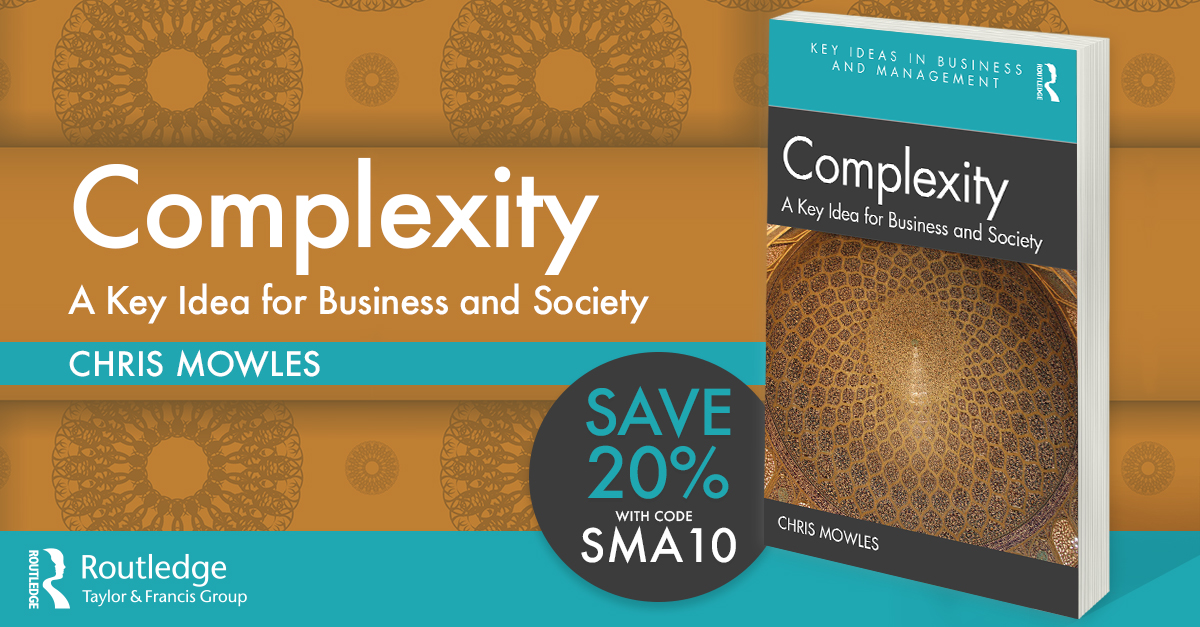
On Friday 3rd June there is a seminar and discussion on my latest book Complexity: a key idea for business and society, which is a way on introducing some of the main concepts informing the perspective of complex responsive processes of relating.

There is an early bird discount until the end of April 2022. Click this link for the conference and/or the introductory seminar.

Write to me with any queries to c.mowles@herts.ac.uk

Organising as complex responsive processes of relating

My latest book, Complexity – a key idea for business and society, arises out of a community of inquiry, where a conversation about complexity and organising which has been going on for more than 20 years.

Contributing to the conversation are my faculty colleagues, Kiran ChauhanEmma CreweKaren Norman, Nick Sarra and Karina Solsø, the students and graduates of the Doctor of Management (DMan) programme at the University of Hertfordshire, and the wider research community who attend the annual conference.

If this video makes you interested in the part time professional doctorate the DMan, which is run psychodynamically, the conference, which this year takes the theme of the theory and practice or anything else, then please get in touch.

The book is available here: https://amzn.to/3GIZYFj . Many thanks to David O’Dwyer of https://lnkd.in/edgdxwgA for making this video.

Complexity and Management Conference 3-5th June 2022 – the theory of practice and the practice of theory

Practitioners often have an ambivalent relationship with theory, and much academic writing may not help. Academic articles can often seem obscure and are usually aimed at other academics rather than managers and consultants working in every day organisational life. Scholars in business schools have long been aware of the problem and have written about the crisis of relevance of organisational scholarship. Equally, there may also be a tendency among consultants to climb aboard the latest bandwagon, to try too quickly to squeeze complex ideas into grids and frameworks, and to instrumentalise. Consultants are paid to know and perhaps to simplify.

How, then to navigate between the potential collapse of important ideas into instrumental two by two girds and frameworks, on the one hand, and the kind of knowledge that is valued in the Academy? What kind of knowledge do we need from practice for practice?

During next year’s Complexity and Management Conference, June 3-5th 2022, we are delighted to welcome Prof Davide Nicolini to help stimulate our thinking about practice and knowledge.  Davide is Professor of Organization Studies at Warwick Business School where he co-directs the IKON Research Centre and co-ordinates the Practice, Process and Institution Research Programme. His current research focuses on the development of the practice-based approach and the refinement and promotion of processual, relational and materialist research methods. 

As usual the currency of the conference is discussion, and the weekend will comprise lots of opportunities to talk about the experience of trying to get things done together. The conference will begin 7pm Friday 3rd June and end at lunchtime on the Sunday. The booking website will go up in the New Year.

Complexity – a key idea for business and society

Coming out at the end of November and turning on 7 types of complexity: thoughts about complex selves, complex action, complex knowledge, complex communication, complex authority and complex ethics, all arising from complex models. A plea for management humility along the way.

Complexity and Management Online Symposium 9.30-5.00pm Sat Nov 20th, 2021. Booking soon!

One of the great promises of an accelerated and globalised world, is that it would increase autonomy, freedom and choice. But that’s not how it has turned out, according to German sociologist Hartmut Rosa . Instead social acceleration has led to greater disorientation and fragmentation and a deficiency of resonance. We find ourselves in frenetic standstill. Nothing remains the same, but nothing essentially changes. The more rapidly changing circumstances oblige us to plan to keep up, the more we realise the plans we do make and our methods of planning are inadequate for the new situations we find ourselves in. Acceleration produces its own disruptions, traffic jams, outages and lacunae.

We are also remade in our relationship with ourselves and with the world. In rapidly changing times greater social advantage is gained by those who have fewer commitments, are more flexible in their sense of self and their convictions. The idea that we might have enduring principals, values if you like, to which we cleave, appears slightly old fashioned. Why would we stand firm for anything in a society which appears to value endless adaptability and flexibility? At the same time we encounter an increase in life events, but a hollowing out of experience, which can lead to depression  and ennui, and an attenuation of resonant relationships. This makes it harder to gain determinacy, to recognise ourselves and others in a shifting world.

Are there advantages to be gained, then by waiting, by dwelling with events to transform them into experience? Is this an argument for staying put, for standing firm, for not rushing on to an idealised future, or at least not yet, but to reflect on what’s going on and to take the time to do so.

The online Complexity and Management Symposium is a good place to do this. The working title is: The Complexity of Waiting. It’s an online event for anyone who enjoys reflecting in large groups and small on the experience of being in relation in the early 21st C.

Enjoy the sense of irony that we have been kept waiting by the university for the booking site to go up. But , it may only be a week before you can collapse the excitement of waiting into the purchase of a ticket for the event. In the meantime, if you would like to offer a workshop in the afternoon related to the theme of the Symposium, please contact me on c.mowles@herts.ac.uk .

I hope to see you there.

Complexity and Management Online Symposium 9.30-5.00pm Sat Nov 20th , 2021

The complexity of waiting.

Your boss summons you for a meeting: she can be late, but it would be unwise for you to be. Or you pass your boss in the corridor as she is talking to another colleague: she asks you to wait while she finishes what she has to say, but the conversation goes on and on. You are doubly frustrated by having to listen to matters which don’t concern you, and by being delayed on the task you are on. Do you dare interrupt and negotiate a meeting at a later time?

These are trivial examples, but being asked to wait often reflects a power relationship, the membership or otherwise of a group, and an indication of social status. The groups of people who are likely to be made to wait the longest are the poor, the unemployed, asylum-seekers, and the otherwise marginalised, who face endless iterations of delay in their dealings with borders or state bureaucracy. Sometimes whole populations of people are asked to wait years, sometimes for generations for a resolution of their displacement and refugee status, like the Palestinians for example. There are hierarchies within societies and between societies and the length of time spent waiting is an index of powerlessness. We have recently witnessed long queues of people waiting to leave the airport in Kabul, while the majority of Afghans have no chance of leaving.

But if you have a first world passport you are unlikely to wait as long in the immigration queue as you are if you are a national of a country in the Global South. If you are a business traveller you are likely to board first and perhaps be accelerated through immigration on your arrival. Money, status, nationality, relationships with the powerful, can all make a difference to gaining access, to being let in, to avoiding bureaucratic entanglements, to getting justice. British citizens are already experiencing their change in status of choosing to leave the EU as they have their passports stamped and join the queue of ‘other nationals’.

But even the privileged have been unable to avoid the uncertain waiting that has afflicted us all during the pandemic. We have been locked down, endlessly waiting, for a resolution, a way out, for hope for the future. In a neoliberal age which privileges action, agency, the constant remaking of the self, we have all experienced, more or less, what it means to have our ability to plan our lives profoundly curtailed. Moreover, we have come to think of ourselves as infinitely networked, speeded up, able to gratify our desires instantly. In contemporary organisations and in normal times we are constantly speeding towards an idealised future. Instead, during the last period we have got used to living with the kind of radical uncertainty that populations in the majority world have long been used to. We are thrown back upon ourselves knowing that our plans are highly contingent on circumstances beyond our control.

In large groups and small, the Complexity and Management Symposium will consider the complexities of waiting, of dwelling in uncertainty. The day will comprise a mixture of small and large groups in the morning and workshops in the afternoon presented by Symposium delegates. If you have an idea for a workshop you would like to present, then please write to me at c.mowles@herts.ac.uk.

I will set up a booking site in the next few weeks on the UH website.

Looking forward to seeing you there.

Complexity and Management: Online Symposium/Practicum November 28th – now booking.

Exploring the complexity of conflict and organising in the time of Covid-19

The Symposium booking site is now open and is available here . You can see the agenda for the day here.

The following is a post by member of DMan faculty Professor Karen Norman which speaks into the theme of the conference:

Exploring the complexity of conflict in organising in the time of Covid: washing our hands of a problem?

Infection prevention and control (IPC) in hospitals is essential at the best of times, but especially so in a time of Covid. From my previous experience as a Board Director responsible for Infection Control in hospitals, I understand the challenges facing staff in maintaining high IPC standards. In 2003, I was involved in a national initiative to reduce the incidence of hospital acquired Methicillin Resistant Staphylococcus Auereus, (MRSA) bacteraemias, because 9% of hospital inpatients had infections acquired whilst in hospital,[1] equating to100,000 incidents a year, costing the National Health Service (NHS) around £1 billion (N.A.O. 2000)[2]. The term ‘hospital acquired infection’ sits uncomfortably with me, given Florence Nightingales’ founding values that hospitals should ‘do the sick no harm.’ A significant causal factor in their spread cited was the poor hand hygiene of the health professionals when caring for patients. Thankfully, progress has been made in recent years, with the hospital I refer to in this blog meeting their target of zero cases of avoidable MRSA in the last year. But what I have noticed amidst the intense discussions we have been having of late with regard to stopping the spread of Covid, is how similar problems are re-surfacing to those we faced when reducing the spread of MRSA, most notably with regard to compliance with ‘best practice’ as set out in our IPC policies and procedures. I share the following narrative to help think about why implementing corporate values such as ‘patient safety’, or ‘doing no harm’ might not be so easy as people seem to think.

Continue reading

Complexity and Management Online Symposium – Sat November 28th 2020

Following the success of this year’s online Complexity and Management Conference on Leadership and Collaboration, and with the encouragement of the delegates who attended, we have decided to hold a one day Symposium this November 28th 2020. The event will also be online and will mark the half way point towards next year’s conference, which we intend holding face to face as usual at Roffey Park, UK, June 4th-6th 2021.

We already have a speaker for next year’s conference 2021: Lyndsey Stonebridge who is Interdisciplinary Chair and Professor of Humanities and Human Rights at Birmingham University. Professor Stonebridge is an international authority on Hannah Arendt and has a book coming out on her work soon.

We ask you to save the date of the Symposium if you are interested in participating while we work up an agenda for the day. The day may well include:

  • Opportunities for delegates to bring current organisational dilemmas to present in a workshop or simply to discuss in break-outs.
  • Contributors to the forthcoming Complexity and Management series of edited volumes might want to rehearse the key themes of their chapters in workshop to see what resonance they have with others.
  • An experiential group.

If you have any other ideas you would like to discuss, or if you would like to present some research, please get in touch. I will communicate more details about the event in the autumn.

Complexity and Management Conference and workshops 5/6th June 2020

Complexity and Collaboration – implications for leadership and practice

The booking sites for the workshops on Friday 5th June and the Complexity and Management Conference on Saturday 6th June are now open to the public.

The workshop Improvising in the complexity of collaboration and conflict on Friday 5th June 9-5pm will explore the enabling constraints of ‘working live’ whilst remaining socially distant from colleagues. The workshop is likely to be most beneficial to delegates who have previously attended one of our programmes or conference, or are familiar with our way of working. Access to Zoom and a desk based PC plus a phone or a tablet is required.

The workshop  is convened Prof Karen Norman, Prof Henry Larsen and colleagues from the Universities of Southern Denmark and Hertfordshire and is open to 20 participants (with a wait list if oversubscribed).

The booking site is here.

The workshop An Introduction to Complex Responsive Processes on Friday 5th June 9-5pm is on the main principles of the perspective of complex responsive processes, which we offer every year. It is a highly participative introduction to complexity and its organisational implications drawing on delegates’ workplace experience, and is offered by Prof Chris Mowles. Maximum 30.

The booking site is here

This year’s conference entitled Complexity and Collaboration – implications for leadership and practice is on Saturday 6th June 9.005 pm and we are delighted to have Prof Barbara Simpson as our keynote speaker from first thing in the morning. The rest of the day will be highly participative and discussive, involving break out groups to discuss the keynote. In the afternoon workshops will be offered by conference delegates on aspects of their work related to the theme. Members of faculty will sum up some of the key themes of the day in a final plenary which will be as participative as the size of the conference will allow online. Maximum 60 people.

The booking site is here.

Looking forward to seeing you there. Apologies if you have already received this information elsewhere.