Tag Archives: complex responsive processes

Last few places remaining – Complexity and Management Conference June 10-12th 2016

What practical difference does it make to take every day organizational experience seriously?

What ways of working may help better illuminate how we co-operate and compete to get things done?

How helpful is it to understand the patterning of human interaction as complex responsive processes of relating?

If you are interested in hearing about some concrete examples where taking a complexity perspective on improving practice and developing strategy has made a difference in organizations in the UK and Denmark, then there are still some remaining places at this year’s conference. This is an opportunity to listen to others, to participate in conversations, as well as to talk about and reflect on  your own work situation.

We can also promise a diverse and interesting group of delegates and good food. The conference fee includes all board and lodging, and the conference begins Friday at 7pm and ends on Sunday lunchtime.

The booking page is here.


Taking complexity seriously – what difference does it make in organisations? 

Complexity and Management Conference June 10-12th 2016

This is a reminder that there is only one month to go to claim your early bird discount for this year’s conference. You can book your place at the conference here: http://tinyurl.com/hougy85

At the conference we will be commemorating the work of Prof John Douglas Griffin who was one of the founders of the Doctor of Management programme at Hertfordshire Business School, and a key contributor to the body of theories we refer to as complex responsive processes of relating.

The conference will be held in the deliberative tradition which Doug loved. The focus of the conference involves exploring practical problems in organisations in the pragmatic school of thought. That is to say it is concerned with what people are doing when they create and recreate their work together, how they think and talk about their work, how we as participants in the conference might think about this further, and gives examples of how thinking, talking and participating differently sometimes brings about changes in patterns of working.

There is an inaugural drinks reception and dinner on Friday night, 10th June @ 7pm. Then there will be two keynotes on Saturday by our guests Prof Henry Larsen, Mark Renshaw, Dr Pernille Thorup, and faculty member Prof Karen Norman who will draw on their experience of trying to get things done in organizations. There will be lots of time for deliberative exploration after each keynote, and many opportunities for agreeing, disagreeing and exploring further. We will also hold a commemoration for Doug in the early evening. On Sunday we will review some of the key themes of the conference and reflect on them some more.

The conference attracts very diverse participants, practitioners and academics, from a wide variety of countries. The conference fee includes all board and lodging.

Complexity and Management Conference 10-12th June 2016 – booking now open

‘What Mead is proposing is a different way of thinking about everyday social interaction, not as observers of experience but rather as participants in experience, the nature of which is self-organising sense-making. He is drawing attention to what we are doing every day in all our actions and arguing that we have developed the habit of ignoring it. How could this be possible? How could we become so blind to something so obvious? Mead’s argument is quite simply that we have developed the habit of regarding the present as something apart from the future and the past. It has become a habit of thought for us to think ourselves as also being apart from our experience as the present movement of time.’ (Griffin, 2002: 179).

The quotation above is taken from Doug Griffin’s book The Emergence of Leadership: Linking Self-Organization and Ethics which was published in 2002, and it points to the focus of this year’s Complexity and Management Conference 2016. As many of you will know, sadly Doug died on 17th December 2015 and we will be celebrating his contribution to the development of the perspective of complex responsive processes and the vibrant life of the Doctor of Management programme at this year’s conference. It was exactly to this area of inquiry, taking everyday complex experience seriously, that Doug was most committed, and the conference is another way of marking and honouring his work.

In this year’s event guest speakers will set out how paying attention to the everyday complexity of experience has made a difference to the work of their particular institution or area of research. The speakers are:

Henry Larsen, Professor of Participatory Innovation at Southern Denmark University, graduate of the DMan programme, ex- member of the Da Capo theatre company. His research interest is in exploring spontaneity and improvisation in the everyday processes of relating.

Professor Karen Norman of Kingston University and doctoral supervisor on the Doctor of Management programme. Karen was formally Chief Nursing Officer in Gibraltar and Director of Nursing for Brighton and Sussex University Hospitals NHS Trust (BSUH).

Mark Renshaw Deputy Chief of Patient Safety at Brighton and Sussex University Hospitals NHS Trust, Mark facilitated a range of quality improvement and patient safety initiatives and co – led the BSUH falls reduction programme – an initiative that started after a patient died after falling in hospital. This work has reduced the incidence of patient falls by 48%  over five years.

Pernille Thorup – Pernille is on the senior management team of COK (Center for Offentlig Kompetenceudvikling), which is the strategic partner in public sector development for KL (Kommunernes Landsforening), the organization of Danish Municipalities. She has recently undertaken a three year strategy process within the company, drawing on insights from the complexity sciences, which has now involved COK’s clients.

We expect the usual richness and diversity of discussion at the conference.

The conference booking page is now live and can be found at: http://tinyurl.com/hougy85 and as usual there is a discount for early-bird bookings.

Look forward to seeing you there.

Complexity and Management Conference 2016 – 10-12th June: Hertfordshire Business School

Complexity and Management Conference 2016 – 10-12th June: Hertfordshire Business School

Taking complexity seriously – what difference does it make in organisations? 

Venue: Roffey Park Management Centre

A familiar question from many managers who respond to our presentations on the relevance of insights from the complexity sciences to people organizing, is to ask what their practical application could possibly be. If they consider step-wise prescriptions for success to be ‘concrete’, or are looking for tools and techniques, then the injunction to take every day experience seriously may sound quite ephemeral. If the focus in strategic management is on the ‘big picture’ and wholesale change, then the recommendation to pay attention to how the ‘whole’ emerges in everyday interaction sounds very surprising. However, with some managers what we describe strikes a chord.

Additionally, the overwhelming majority of 60-plus graduates of the Doctor of Management programme have found the experience of paying attention to their practice with others transformative, both for themselves and for the organisations in which they work. Every year participants in the annual Complexity and Management conference, who come from a variety of organisational backgrounds, bring many examples of how taking the everyday complexity of organizational life seriously makes a difference to expanding possibilities for action. This experience is matched by an increased focus in the scholarly literature on everyday processes of organizing.

In this year’s conference we will discuss the complexity of practice and the difference it makes to pay attention to what we are all doing together to get things done.

Our key note speakers are:

Session 1

Henry Larsen, Professor of Participatory Innovation at Southern Denmark University, graduate of the DMan programme, ex- member of the Da Capo theatre company. His research interest is in exploring spontaneity and improvisation in the everyday processes of relating.

Professor Karen Norman of Kingston University and doctoral supervisor on the Doctor of Management programme. Karen was formally Chief Nursing Officer in Gibraltar and Director of Nursing for Brighton and Sussex University Hospitals NHS Trust (BSUH). She is also a graduate of the DMan programme and continues to take an interest in drawing on insights from complexity theory to inform clinical practice aimed at improving the experience of health care for patients.

Mark Renshaw Deputy Chief of Patient Safety at Brighton and Sussex University Hospitals NHS Trust, Mark facilitated a range of quality improvement and patient safety initiatives and co – led the BSUH falls reduction programme – an initiative that started after a patient died after falling in hospital. This work has reduced the incidence of patient falls by 48%  over five years.  His role has allowed him to explore his interest in complex systems and how behavioural change in clinical practice emerges out of group dynamics and professional ‘habitus.’

Henry, Karen and Mark will talk about their collaborative research project on reducing patient falls.

Session 2

Pernille Thorup – Pernille is on the senior management team of COK (Center for Offentlig Kompetenceudvikling), which is the strategic partner in public sector development for KL (Kommunernes Landsforening), the organization of Danish Municipalities. She has recently undertaken a three year strategy process within the company, drawing on insights from the complexity sciences, which has now involved COK’s clients. The changes in her own organisation and the discussion this has provoked in Denmark more widely, will form the subject of her talk.

A booking page on the university website will be uploaded in the New Year.


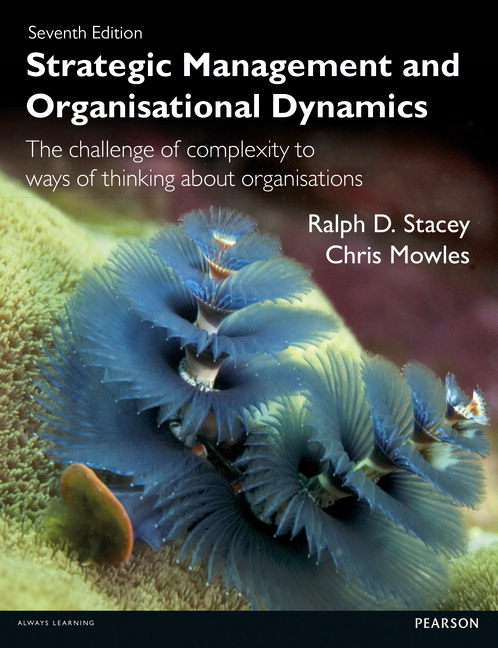
Strategic Management and Organisational Dynamics – 7th Edition

New edition published this month: the revised and updated version of Ralph’s textbook including sections on process organisation studies, new organisational  examples and more up-to-date references.

Stacey and Mowles

Complex responsive processes in Denmark

The following post is written by Karina Solsø Iversen, who is a senior consultant at Attractor in Denmark and a student on the Doctor of Management programme at the University of Hertfordshire.

Danish book on complex responsive processes48298a4459ca41cea19879115e574244-plusclubmaxi

It is a Friday night at7.30. The sun is shining outside in the beautiful garden of Roffey Park Institute which is the location for the quarterly residentials on the doctorate program (DMan) of the complexity and management research group. I sit in the lounge together with my new colleagues whom I have just met a few hours ago. This is my first residential. One of my new colleagues, Mick asks me: What are you doing as a professional? Happy that someone is interested in getting to know me I reply that I work as a consultant. He asks me what I do then. I tell him that I am a process consultant working with organizational development. He looks at me in a mischievous way and asks me once again the exact same question – what do I do then? Somewhat irritated and a bit insecure about what is going on, feeling like I am taking part in a test, I reply that I facilitate conversations between people coming from different departments, professions or hierarchies in order for them to create solutions together. Mick smiles and asks me once again what I then actually do …

A few months ago, my DMan colleague Pernille Thorup and I published a Danish introductory book on complex responsive processes. In Danish it is called: Leadership in Complexity. An introduction to Ralph Stacey’s theory about organization and leadership. Continue reading

Complexity and Management Conference 5th-7th June 2015

This is just to remind you that if you book your place for the Complexity and Management Conference June 5-7th before the end of April you get a £50 early-bird discount. The link to go to the university booking page is here: http://tinyurl.com/k7t2rd4
The theme for the conference is:
Exploring our experience of everyday politics in organisations.
 
Our key note speakers are Prof Svend Brinkmann of Aalborg University and Prof Patricia Shaw formerly of the Complexity and Management Group at UH and now at Schumacher College.
Looking forward to seeing you there.

Against Common Sense: managing amid the paradoxes of everyday organisational life

The following is the text of a talk given by Chris Mowles at the University of Hertfordshire on Friday Feb 13th as part of the MBA Masterclass series.

In this talk I try to cover four things:

I address why I think there is a problem with much contemporary management theory and explain why I think it is necessary to argue against what is taken to be common sense in management.Unknown

I introduce paradox and explain its roots in philosophy and point to how it manifests itself in the complexity sciences, as an alternative to some of the simplified assumptions and dualisms in much contemporary management theory.

I give some examples of how paradox manifests itself in everyday organisational life.

And finally I suggest some implications for managers for taking paradox seriously for what they might find themselves doing at work.

Why against common sense?

I am using the title of this talk, against common sense, to make a general critique of what we might think of as the majority literature on management, but also to highlight the meaning of the word paradox, from the Greek para doxa, or against what people ordinarily hold to be true. In using the term ‘majority literature’, I am not trying to suggest that all management literature suggests the same thing, or that all business schools teach the subject uncritically (this is certainly not the case at the University of Hertfordshire and on the MBA, for example). There is a flourishing substantial minority critical tradition in management theory.

But overwhelmingly, orthodox management journals and books assume that managers are in control, can predict and design organisational futures and organisational culture, can purpose transformation and innovation. Even when the majority literature identifies contradiction or paradox as a phenomenon, it argues that managers can control this too, often suggesting that paradox can be ‘unleashed’ for the creative good of the organisation, or can be brought into dynamic balance.[i] Continue reading

Complexity and Management Conference 5-7th June 2015

Exploring our experience of everyday politics in organisations.
 
How do we experience power and politics in contemporary organisations? How do we negotiate conflict and compromise? There are always possibilities in the hurly burly of everyday life for us to act differently despite the fact that we are caught up in longer term social trends which constrain our ability to think and act. So what are our degrees of freedom?
This year’s Complexity and Management Conference will explore these themes and more. The conference will be highly participative, and will be based on some presentations followed by discussion in groups, drawing on participants’ experience.
Our key note speakers are Prof Svend Brinkmann of Aalborg University and Prof Patricia Shaw formerly of the Complexity and Management Group at UH and now at Schumacher College.
The registration site for the conference is now open and an early-bird discount applies to all participants who book before April 30th. The booking page can be found here: http://tinyurl.com/k7t2rd4  The fee for the conference includes accommodation and food from Friday evening through to Sunday lunchtime.
Anyone wishing to put forward suggestions for discussion groups please contact me: c.mowles@herts.ac.uk
Looking forward to seeing you there.

Predictability and Organisations

Yesterday, I was struck by an article in the Business Section of the Sunday Times with this heading: Directors told to predict future under new code. That I should be struck by such a heading is, of course, hardly surprising since I have been publishing books and papers for the last 24 years arguing that it is impossible to predict the outcomes of the actions  people undertake in organisations. Indeed, the paradox of predictable unpredictability of human actions is central to the theory of complex responsive processes. The fundamental reason for this paradox is that that we are interdependent individuals, not autonomous individuals. This means that every choice any one of us makes, any intention any one of us forms and every action any one of us undertakes cannot produce some direct outcome all on its own because everyone around us, indeed many at some distance from us, are also choosing, intending and acting so that what happens is the consequence of the interplay of all our choices, intentions and actions. The models of the complexity sciences also display the unpredictability of outcomes because nonlinear relationship can escalate tiny changes to produce completely unpredictable long term outcomes. Indeed, some of the models, for example, those of far-from-equilibrium thermodynamics, lead to the conclusion that the universe is fundamentally unpredictable. And, in fact, our own experience confirms these conclusions about unpredictability.


In view of all of this it is amazing how prominent leaders in the organisational world carry any giving out predictions which, of course, are never realised. Take for example the Governor of the Bank of England. A year ago now, Mark Carney took up his post as Governor of the Bank of England after some years as Governor of the Bank of Canada. The first really headline-grabbing action he took was to provide what he called ‘forward guidance’ to the financial markets. He would only raise interest rates if the unemployment rate fell below 7% and he said that this would not happen before 2016. The market did not believe him and began to price in an interest rate increase in 2015. Only a few months later it became clear that unemployment was falling much faster than expected and would probably reach that target by the end of 2013. So the Governor hastily abandoned this target and proposed to use a number of indicators of economic ‘slack’. Just as well because the unemployment rate in May this year fell to 6.6%. What is interesting is how, after it became crystal clear that neither he nor anyone else could predict any economic indicator, he rushed from one failed prediction to others just as likely to fail. He does not seem to have reached the sensible conclusion, which is to abandon all of these useless attempts to predict. Then in his most recent speech he let slip that the interest rate rise could well come in a few months’ time. Why do senior people keep making claims for the future which experience would tell them are futile?


Now back to the newspaper article which tells a similar story. The Financial Reporting Council (FRC) commissioned the Liberal Democrat peer and former chairman of the insurer Aviva, Lord Sharman, to lead an expert panel to revamp the going concern test for organisations since the current test had failed to pick up the vulnerability of the banks in 2008. After months of deliberation and a number of rounds of consultation they produced their recommendation of a new corporate governance code for one last round of consultation. They will recommend that Directors be required to tell investors how long they think their company will remain viable: they must declare that their companies are viable for the foreseeable future and the foreseeable future has to exceed 12 months. So a group of eminent people spend months, and no doubt a lot of money, to come up with a recommendation which simplistically assumes that the future is predictable when in our experience it clearly is not. Even more interesting is the response of investors and trade bodies. For example, John Moulton, the veteran venture capitalist who runs Better Capital, said: ‘It is madness. No company will be able to come up with the right answer’. The panel says they will consider this point. So the great and the good continue to formulate policies on the basis of some very dodgy assumptions, which they never reflect upon, while those they are trying to protect make clear their knowledge that such protection is impossible. It looks like some who make a great deal of money do not operate on outdated assumptions.


Why are we so caught in a way of thinking that denies our experience? I think it is because the great and the good constitute a ‘thought collective’ in the terms of Ludwik Flek. In a previous blog I talked about Flek’s conclusion that we all belong to some thought collective and each of these collectives is characterised by a thought style. To question such a thought style is to risk exclusion from the thought collective. And it is not just policy makers and leaders of large organisations who are trapped in a ‘thought collective’. Some of the most effectively policed thought collectives are to found in academia where journals control what can be published and business schools continue to teach students all kinds of misleading ideas about predictability and the use of tools and techniques.