Tag Archives: Complexity and Management Conference

The entrepreneurial self and the social self: reflections on the 2016 CMC

Here are a series of articles which illustrate the way in which business vocabulary has entered into our way of talking about ourselves and our relationships:

This is from Forbes magazine and suggests you treat yourself as a product and a brand.

Screenshot 2016-06-14 12.38.12

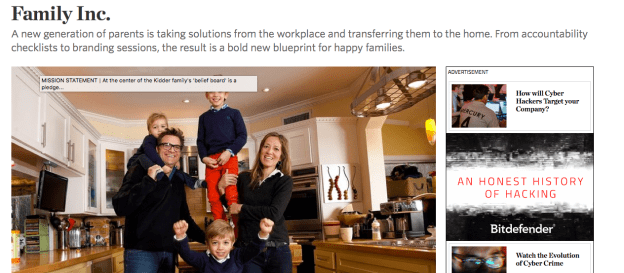
This is from the Wall St Journal and shows a family who have pinned a mission statement to their fridge and have agreed targets for each other.

Screenshot 2016-06-14 12.44.19

Continue reading

Last few places remaining – Complexity and Management Conference June 10-12th 2016

What practical difference does it make to take every day organizational experience seriously?

What ways of working may help better illuminate how we co-operate and compete to get things done?

How helpful is it to understand the patterning of human interaction as complex responsive processes of relating?

If you are interested in hearing about some concrete examples where taking a complexity perspective on improving practice and developing strategy has made a difference in organizations in the UK and Denmark, then there are still some remaining places at this year’s conference. This is an opportunity to listen to others, to participate in conversations, as well as to talk about and reflect on  your own work situation.

We can also promise a diverse and interesting group of delegates and good food. The conference fee includes all board and lodging, and the conference begins Friday at 7pm and ends on Sunday lunchtime.

The booking page is here.


Politics, impartiality, reflexivity – reflections on the 2015 Complexity and Management Conference

I promised to write up my presentation from the 2015 Complexity and Management Conference, which was entitled Exploring our Experience of Every Day Politics in Organizations. My task was to pull out a few themes which struck me, and to respond to the keynotes of Svend Brinkmann and Patricia Shaw. This post tries to identity common threads, lacunae and opportunities for thinking arising out of what our guests said and links these to reflections on what it might mean to reflect systematically on the politics of everyday life in organisations. Continue reading

Complexity and Management Conference June 2015 – themes and agenda

At the Complexity and Management Conference this weekend (5th-7th June at Roffey Park) we will be discussing a variety of themes concerning power and politics in organisations. As a small contribution to the discussion I offer the following:

There are two managerial tendencies in contemporary organisations which in my view work against the exploration of difference, and cover over the opportunity for collective reflection.

The first is the increasing prevalence of instrumental reason in the shape of rhetorical appeals to ‘what works’, or what ‘adds value’ or is best for effectiveness and efficiency.  This is not to argue in favour of inefficiency or ineffectiveness, or allowing employees to do whatever they want, but if we start from the premiss that there is no one best strategy, then all options about what employees might do together to improve organisational outcomes will bring with them advantages and disadvantages. It depends when the evaluation is made, and who is judging.

If the future is uncertain then we can never be sure what will work and what will not until we try something together, and even then we may disagree about what we find. So it may be worth exploring the merits of different courses of action and tolerating dissent, disagreement and contestation before we embark upon something.

The second tendency can arise as a direct result of the first, that there is a lack of shared experience of deliberating together, and therefore a greater reluctance to consider it. All kinds of reasons are given for not thinking together: because there isn’t time, because it will open a can of worms, because it will be just a talking shop, because it’s a luxury we can’t afford, because we’re an action-oriented organisation. In effect what then happens is a closing down of opportunity to seek different perspectives which prevents bringing about what Hannah Arendt referred to as ‘enlarged mentality’, the possibility of experiencing human plurality. The ability to consider the perspective of others was of prime importance to Arendt, since it enables us to decentre ourselves and avoid narcissism, as well as preventing tyranny where there is only a hearing for one point of view.

Another aspect of deliberating together in public, particularly when we are face to face, is that the intimacy of being together obliges us more actively to find ways forward. But confronting each other with our differences can be painful, and it isn’t always easy to do.

These are some of the themes we will be struggling with, more or less painfully,  on the weekend, and here is the rough agenda for the discussions.

Look forward to seeing you there if you have registered, and if not we will try and post some reflections on what happened afterwards.

Complexity and Management Conference 5-7th June 2015

Conference theme: Exploring our experience of everyday politics in organisations

How do we negotiate degrees of freedom with each other in what we can increasingly experience as regimes of disciplinary power in organisational life? How do grand schemes for whole-organisation transformation play out in every day relationships between people?

This conference will invite participants to discuss and reflect upon the every day politics of getting things done together, noticing the negotiations, compromises and improvisations which are necessary to take the next step.

Between now and then we will be posting further reflections on the topic on this the Complexity and Management blog.

The key note speakers this year are  Svend Brinkmann,  who is Professor in general psychology and qualitative methods as well as Co-director of the Center for Qualitative Studies, and Professor Patricia Shaw, co-founder of the Doctor of Management programme at UH and currently working at Schumacher College. Here is Svend’s profile page at Aalborg university http://personprofil.aau.dk/117579?lang=en and here is Patricia Shaw’s at Schumacher College: http://www.schumachercollege.org.uk/teachers/patricia-shaw .

The conference will be informal and highly participative, as in previous years. The conference fee includes accommodation and food and will be held at Roffey Park Institute in the UK: http://www.roffeypark.com

The booking page on the university website will be set up in the New Year.

A more detailed agenda will follow, but the conference begins with a drinks reception @7pm on Friday 5th June and ends after lunch Sunday 7th June 2015.

Participants wishing to set up a particular themed discussion in a working group during the conference should contact Chris Mowles: c.mowles@herts.ac.uk

Complexity and Management Conference, 6-8th June 2014

Only one week to go before the close of the early bird rate for this year’s Complexity and Management Conference on organisational culture.

Book here.

Key note speaker: Prof Ralph Stacey

Good conversation, good food, great venue.

Now booking! Complexity and Management Conference June 6-8th 2014

Can leaders change organisational culture? – alternatives from a complexity perspectiveImage

What do we mean when we talk about the ‘need to change organisational culture’? This is a way of speaking about culture which is now taken for granted, whether in relation to banking, the UK’s National Health Service or sometimes whole societies. What is organisational culture anyway, and to what extent can even the most powerful leaders and managers (or politicians) change it in ways that they decide? And if we were to conclude that it’s not possible to change culture, at least not in predictable ways, then why has this way of speaking and thinking become so widespread? What else might be going on, and what purpose does the culture-change narrative serve?

This year’s Complexity and Management Conference will follow on from last year’s discussion of leadership and will encourage the exploration of a term which is widely used but poorly understood. Participants will be encouraged to share their own experiences of organisational change, particularly when it is framed in terms of changes in culture. We will explore together the implications of the discourse of culture change for leaders and managers.

The key note speaker this year is Prof Ralph Staceyco-founder of the Doctor of Management programme at UH and a groundbreaking scholar with his work on the complexity sciences and their relevance to leading and managing organisations.

The conference will be informal and highly participative, as in previous years. The conference fee will include all accommodation and food. The conference will be held at Roffey Park Institute in the UK: http://www.roffeypark.com as usual.

The booking page can be found here. There is a discount for early-bird bookings before May 1st 2014. A more detailed agenda will follow but the conference begins with a drinks reception @7pm on Friday 6th June and ends after lunch Sunday 8th June.

Participants wishing to set up a particular themed discussion in a working group during the conference should contact Chris Mowles: c.mowles@herts.ac.uk

Complexity and Management Conference 7-9th June 2013 – Agenda

 Exploring the Cult of Leadership – alternative ideas from relational and complex responsive processes perspectives.

This is just to remind those of you interested in coming to the 2013 Complexity and Management Conference that there are just a few days left before the early bird discount expires on Friday 26th April.

You can find a copy of the agenda for the three days here: CMC June 2013.

And you can go the University of Hertfordshire booking page here: http://tinyurl.com/crm734w

Complexity and Management Conference 7-9th June 2013 – Exploring the Cult of Leadership alternative ideas from relational and complex responsive processes perspectives.

Key note speaker: Professor Ann Cunliffe
This is just to draw to your attention to the fact that the early bird rate for the CMC, which saves you £50 on the full conference fee, ends on Friday 26th April.
You can book on the university website here: http://tinyurl.com/crm734w

Complexity and Management Conference, 7-9th June 2013

Exploring the cult of leadership: alternative ideas from relational and complex responsive processes perspectives.

During the past 10-15 years there has been a proliferation of leadership programmes run by business schools, consultancy companies and training organisations. Leadership development is routinely offered to employees throughout organisations, private and public, irrespective of whether staff lead, or intend to lead others or not. It is a prerequisite to have had leadership training and to aspire to leadership positions for organisational advancement, or even to take up an ordinary career. Many of these programmes draw on a host of contradictory books and journal articles which continue to be produced in large numbers. In the UK and throughout North America and Europe, and even in the developing world, there is no avoiding the discussion of leadership in contemporary organisational life. Leadership, and aspiring to be a leader, have become a cult value.

And yet the more that is furnished in the way of leadership literature and development programmes, the less clear it is what we are actually talking about. Current discussion of leadership tends to veer between depicting failures of leadership, often attributed to weak individuals or failing ‘systems’, or idealising conceptions of the leader-as-hero.  The first approach covers over what people are actually doing with each other at work, while the latter calls out the possibility of a commensurate degree of disappointment when our leaders are revealed to have feet of clay. As the Harvard professor Rakesh Khurana (2007) put it when he reflected on the sorry state of leadership scholarship in his book From Higher Aims to Hired Hands:

‘From a scholarly perspective, then, leadership as a body of knowledge, after decades of scholarly attention under the social sciences research lens that the Ford Foundation found so eminently promising, remains without either a widely accepted theoretical framework or a cumulative empirical understanding leading to a usable body of knowledge. Moreover, the probability that leadership studies will make significant strides in developing a fundamental knowledge base is fairly low.’ (2007: 357) Continue reading