Tag Archives: leadership

Complexity and organisations – researching practice

Complexity and Organisations: researching practice, the fourth volume in the Complexity and Management new series is published at the end of this month. Produced by the complexity research community at Hertfordshire Business School, the book explores how we can take complexity seriously as we inquire into our working worlds.
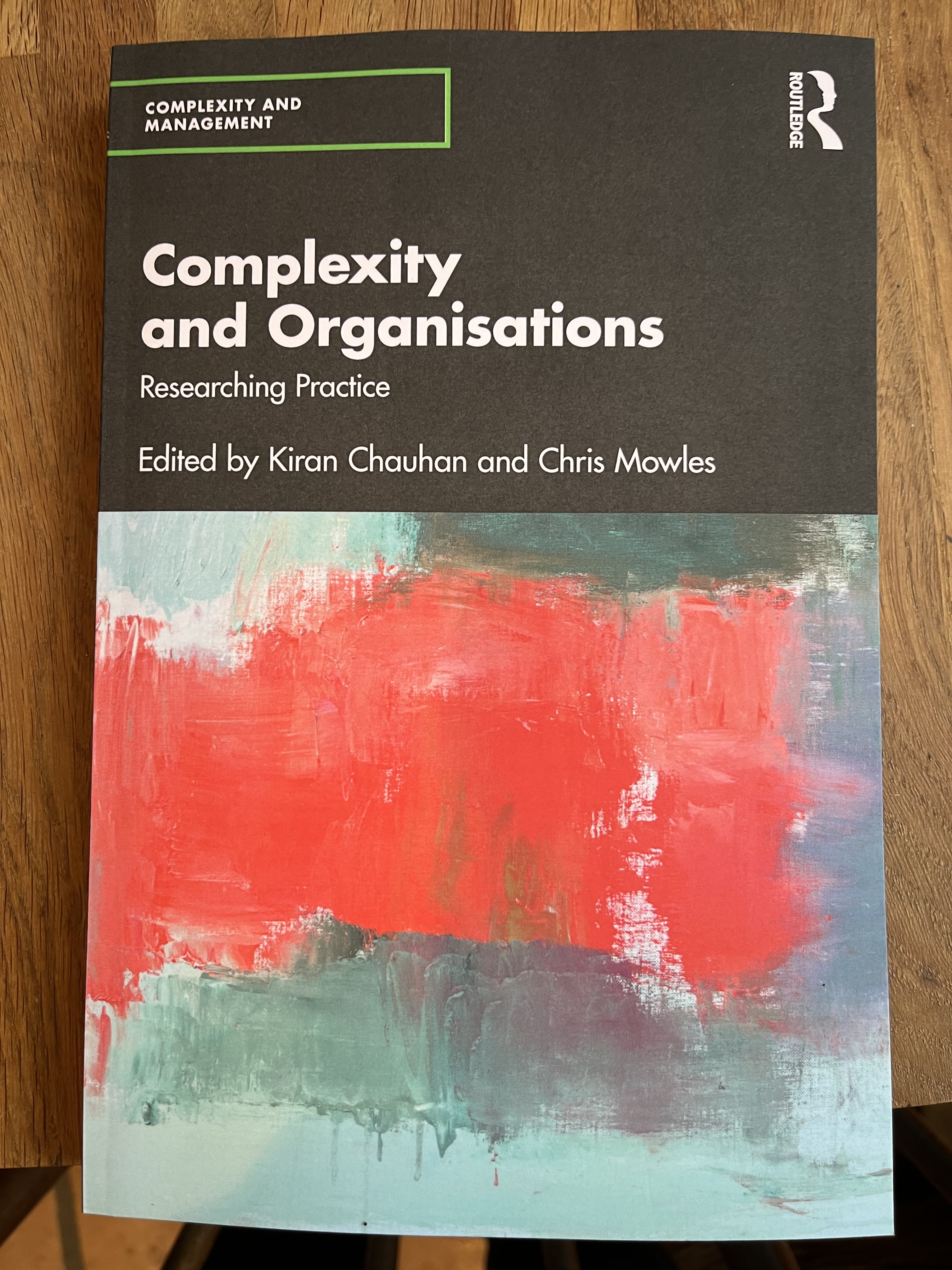
Drawing on their experiences as leaders, managers, researchers and educators, the contributing authors offer insights about exploring social life without trying to reduce or simplify it’s messiness and unpredictability. Addressing themes of history, culture and belonging, compromise, doubt, confidence and its lack, grief and loss, actors and non-human actors, ethics, values and politics, they provide accounts of taking experience seriously, of mobilising our capacity for reflexivity, with all its limitations, in pursuit of understanding more of what it is to be humans amongst humans trying to get stuff done together. 

In doing so they make a number of assumptions about organisations and social life more generally.

At the core of organisational life are fluctuating relationships: I am because we are. There are limits to how much we can make the world in our own image, choose, predict and control as if we were autonomous, rational individuals.

We make organisations but organisations make us, a position which deflates the omnipotent assumption that managers and leaders can ‘create cultures’ of their choosing bend the future to their will. We are more influenced than influencing and paying attention to the push-pull of power relationships may give us greater insight into the qualities and limitations of our agency. We are all caught up in the game of organisational life, so how does the game affect us and our sense of belonging and identity; how are we affecting others?

If we are to illuminate how things became the way they are, it matters that we try and understand practical dilemmas in their history and context, and notice specific human bodies acting and speaking in particular ways. We are all shaped by broader social trends which play out differently in different organisations at different times. Management methods taught in business schools may be helpful in general, but we work with known others in the particular here and now. What can we say about the paradox of negotiating with particular others about general dilemmas that help us better understand the tasks we have before us?

Humans are both complex and flawed. Contemporary organisations acknowledge feeling to the extent that it can be harnessed for organisational ends. We are allowed to be passionate, positive and collaborative, but being political, rivalrous and critical are harder to take account of and speak about. Perhaps we can only be wiser about organisations if we can be wiser about ourselves, and our flawed human nature is the crack through which the light gets in. Our anxiety in the face of uncertainty, our need to belong and be recognised our competitive-cooperative impulses, all contribute to the flux and change of organisational life.

Suitable for the curious and the perplexed, whether you are consultants, pracademics, managers or leaders, this volume is a field guide for making better sense of everyday complexity.

Chapters by Drs Kiran Chauhan, Sune Bjørn Larsen, Sophie Wong, Karina Solsø Iversen, Mikkel Brahm, Helle Stoltz, Jannie Rasmussen, Tobit Emmens and Maj Karin Askeland.


Complexity & Management Conference 6-8th June 2025

Transformative possibilities in the everyday – habit, affect and the unconscious

I was recently in a training being inducted into a new leadership programme. The course facilitators placed a heavy emphasis on bringing about changed ‘behaviours’ in those who were to study on the programme. Implicit in this focus is the idea that we know in advance what leaderly activity looks like. Additionally, the use of the plural ‘behaviours’, carries a false precision. The idea, I suppose, is that these ‘behaviours’ are identifiable and measurable, contributing to ‘evidence’ that someone has learned the leadership skills that are required, and can bring about the expected  ‘transformation’.

This programme is not at all unusual in having designs on our habitual conduct. Our family groups, the organisations we work for, the societies we live in all shape our every day behaviour, our habitual ways of dealing with each other, and may have aspirations for shaping them further: to make us conform, to make us cohere with others, to behave respectfully, to help groups work, to encourage us to spend more and commit more. While our socialisation may take  place largely prereflectively and unconsciously, in advanced capitalist economies there are algorithms, marketing and advertising disciplines which deliberately seek to direct our everyday actions towards certain ends. We live in an economy of persuasion. To what extent do we notice and become mindful of the ways in which our habits are shaped and how try to shape others?

From a pragmatic perspective, concentrating on the actions of one individual, whether they are in a leadership position or not, leaves out a great deal. For example, the leader may propose, but how does everyone else respond? Until we take the gesture and the response together we cannot begin to understand what an action means. And what kind of feelings are evoked in the exchange? To what degree are the habitual patterns of relating affected by the leader’s ‘behaviours’ as opposed to the broader game of games which is taking place in the organisation and beyond? How does the unconscious manifest in group dynamics, particularly if the group is anxious and uncertain? To what degree do context, time and artefacts make a difference?

While organisations tend to have grand schemes of wholesale transformation, change is a complex and uncertain undertaking.  From a complexity perspective, whatever we take transformation to be it is just as likely to arise from the micro, the minor gesture, the adjustments of habit in the every day following a break down, which can escalate into population-wide change.

At next year’s conference we are delighted to have Carolyn Pedwell, Professor of Digital Media in the Sociology Department at Lancaster University,  as key note speaker to explore these themes with us. Amongst Carolyn’s publications is her book Revolutionary Routines: The Habits of Social Transformation (McGill-Queens UP, 2021), which explores the paradoxical quality of habits, which enact the possibility of continuity and change both at the same time.

The conference begins on Friday 6th June 2025 and finishes at lunchtime on Sunday 8th. The currency of the conference is conversation and exploration in large groups and small.

I will put up a payment site in the New Year. Look forward to seeing you there.

Reminder – Complexity and Management Conference 2nd-4th June 2023

Complexity, uncertainty, breakdown: coping, recovering and finding hope in dark times.

The naïve discourse about disruption presents it as the preserve of charismatic tech gurus or as an instrument of management that has the potential for bringing about transformation for the good. Our every day experience of disruption is that it emerges as a consequence of longer term socio-economic trends, the interweaving of intentions, of which no one is in control, not governments, and certainly not senior management teams. There may indeed be opportunities which arise from extremely turbulent times, but there are also costs: winners and losers, threats to identity and a sense of permanent dislocation from ourselves and from others.

What does it mean to collaborate when the ground is always shifting? Where are the sources of hope? What are more or less helpful ways of dealing with uncertainty beyond the tired prescriptions of many contemporary management perspectives?

This is a reminder that the Complexity and Management Conference 2023 will address what can feel like a constant state of breakdown, potentially undermining things we may previously have taken for granted, such as plans, rules, loyalties, markets, knowledge, and how we exercise authority in groups.

The conference will be organised around contributors to the recent Complexity and Management series published by Routledge, which include the titles Complexity and ConsultancyComplexity and Leadership and Complexity and the Public Sector. Contributors will talk about their experience of leading, managing and consulting to a wide range of organisations, particularly the public sector. An invitation is also extended to all delegates attending the conference who want to offer a workshop on Saturday afternoon 3rd June.

If you are interested in the difference it makes to take the complex interplay of relationships seriously, particularly in dark times, then book for the conference, 2nd-4th June. The conference is highly discussive and conversation is the currency of participation. It will greatly enhance the conference if delegates bring concrete examples of their workplace dilemmas. Participants are encouraged to offer workshops on something they are currently working on.

The conference is organised in collaboration with KIOL Executive Programme at University College Copenhagen.

The booking site will be opening soon and offers an early-bird discount until the end of April.

Complexity and Management Conference and workshops 5/6th June 2020

Complexity and Collaboration – implications for leadership and practice

The booking sites for the workshops on Friday 5th June and the Complexity and Management Conference on Saturday 6th June are now open to the public.

The workshop Improvising in the complexity of collaboration and conflict on Friday 5th June 9-5pm will explore the enabling constraints of ‘working live’ whilst remaining socially distant from colleagues. The workshop is likely to be most beneficial to delegates who have previously attended one of our programmes or conference, or are familiar with our way of working. Access to Zoom and a desk based PC plus a phone or a tablet is required.

The workshop  is convened Prof Karen Norman, Prof Henry Larsen and colleagues from the Universities of Southern Denmark and Hertfordshire and is open to 20 participants (with a wait list if oversubscribed).

The booking site is here.

The workshop An Introduction to Complex Responsive Processes on Friday 5th June 9-5pm is on the main principles of the perspective of complex responsive processes, which we offer every year. It is a highly participative introduction to complexity and its organisational implications drawing on delegates’ workplace experience, and is offered by Prof Chris Mowles. Maximum 30.

The booking site is here

This year’s conference entitled Complexity and Collaboration – implications for leadership and practice is on Saturday 6th June 9.005 pm and we are delighted to have Prof Barbara Simpson as our keynote speaker from first thing in the morning. The rest of the day will be highly participative and discussive, involving break out groups to discuss the keynote. In the afternoon workshops will be offered by conference delegates on aspects of their work related to the theme. Members of faculty will sum up some of the key themes of the day in a final plenary which will be as participative as the size of the conference will allow online. Maximum 60 people.

The booking site is here.

Looking forward to seeing you there. Apologies if you have already received this information elsewhere.


Complexity and Management Conference on Collaboration 5-7th June 2020. Booking open now.

Complexity and Collaboration – implications for leadership and practice

Being part of a group engaged in a joint enterprise provokes all kinds of mixed feelings and responses in people: it can be uplifting and satisfying, while at the same time triggering frustrations and petty rivalries. Without other people it’s hard to get work done, while at the same time work would be easy if it weren’t for other people. Collaboration pitches us into the uncertainty of exploring our interdependencies with others. It has also become a buzz-word in contemporary organisational life and has been linked to idealisations of innovation, trust and highskydiving-functioning teams. But is collaboration more like happiness – we will know after we have collaborated successfully that we have done so, but the moment we set it up as a goal to be achieved instrumentally it will continue to evade our grasp? When are we collaborating and when are we colluding?

This year’s Complexity and Management Conference 5-7th June at Roffey Park near Horsham UK , will take the experience of collaboration seriously and explore the implications for management, leadership and practice more generally. To support us with the task Prof Barbara Simpson has kindly agreed to be our key note speaker on Saturday 6th June. In the afternoon of the Saturday there will be workshops led by conference delegates linked to the conference theme. If you would like to put your name forward to convene such a workshop, please let me know.

On Friday 5th June there are two one day workshops. One is an introduction to the perspective of complex responsive processes, which informs the professional doctorate, the DMan, offered by the University of Hertfordshire. This workshop is suitable for people who would like a basic introduction to the ideas and is convened by Prof Chris Mowles. The second workshop, Improvising in the complexity of collaboration and conflict, introduces techniques of improvised theatre through ‘working live’ with professional actors on participants’ stories from their workplace. The workshop is convened by Prod Henry Larsen and Prof Karen Norman.

The conference booking page is now open and can be accessed here. Workshops and conference can be booked separately and together. The conference fee comprises all board and lodging.


Now booking! Complexity and Management Conference June 6-8th 2014

Can leaders change organisational culture? – alternatives from a complexity perspectiveImage

What do we mean when we talk about the ‘need to change organisational culture’? This is a way of speaking about culture which is now taken for granted, whether in relation to banking, the UK’s National Health Service or sometimes whole societies. What is organisational culture anyway, and to what extent can even the most powerful leaders and managers (or politicians) change it in ways that they decide? And if we were to conclude that it’s not possible to change culture, at least not in predictable ways, then why has this way of speaking and thinking become so widespread? What else might be going on, and what purpose does the culture-change narrative serve?

This year’s Complexity and Management Conference will follow on from last year’s discussion of leadership and will encourage the exploration of a term which is widely used but poorly understood. Participants will be encouraged to share their own experiences of organisational change, particularly when it is framed in terms of changes in culture. We will explore together the implications of the discourse of culture change for leaders and managers.

The key note speaker this year is Prof Ralph Staceyco-founder of the Doctor of Management programme at UH and a groundbreaking scholar with his work on the complexity sciences and their relevance to leading and managing organisations.

The conference will be informal and highly participative, as in previous years. The conference fee will include all accommodation and food. The conference will be held at Roffey Park Institute in the UK: http://www.roffeypark.com as usual.

The booking page can be found here. There is a discount for early-bird bookings before May 1st 2014. A more detailed agenda will follow but the conference begins with a drinks reception @7pm on Friday 6th June and ends after lunch Sunday 8th June.

Participants wishing to set up a particular themed discussion in a working group during the conference should contact Chris Mowles: c.mowles@herts.ac.uk

Changing organisational culture: a moral and disciplinary project

This post is another contribution to thinking about organizational culture in preparation for the Complexity and Management Conference due to be held 7-9th June this year, 2014, which will be dedicated to this theme.

The Christmas period provided a very good example of the dominant thinking about organisational culture change, which I wrote about earlier in a previous post on this blog here. The new CEO of Barclays Bank, Anthony Jenkins was the guest editor for BBC Radio 4’s flagship news programme, Today, and he used the opportunity to draw attention to ethics, leadership and organisational transformation. You can find some of the clips from the programme here.

The banking world in general and Barclays in particular have been rocked by a number of scandals, including mis-selling of financial products and the manipulation of the inter-bank lending rate, LIBOR. Jenkins sees his task as rebuilding the bank and restoring public trust by ‘transforming the culture’ of the bank away from short-termism and a narrow definition of maximising shareholder value which he feels has predominated over the last 30 years, towards an understanding the banks serve society at large.th

To achieve this Jenkins has started a review of all the bank’s activities and has set alongside it an organisational change programme called Transform. The Transform programme sets out what Jenkins describes as five core values: respect, integrity, service, excellence and stewardship. All of these are to be ‘embedded’ in the organisations and measured episodically with numerical scores to give a reading of the bank’s progress towards operating differently. To give a token of his seriousness, Jenkins argues that he and his colleagues have developed a set of ‘explicit behaviours’ which staff have to exhibit in order to demonstrate the values. They will be recruited, promoted and developed according to these standards. According to Jenkins this change in culture will take up to ten years. Continue reading

On organisational culture change

There is a great deal of discussion in contemporary organisational life of the need to ‘change the culture’ in organisations. This is a way of talking that assumes that organizations do have discrete cultures and that they are manipulable, although the discourse can have it both ways with the term: on the one hand culture is known to be symbolic, intangible and abstract, on the other it can be the object of conscious and rational redesign and reframing. A good example of this way of talking about organisational culture can be found in the 4th edition of the eminent management scholar Edgar Schein’s book Organizational Culture and Leadership[1].

Usually a prime role is assumed for leaders or senior managers in making the changes to organizational culture because they are considered to have the necessary abilities and skills to diagnose what is wrong with the current culture and to design a better one: one which fits better with the environment. Schein states this very explicitly in his book: ‘In this sense culture is ultimately created, embedded, evolved and ultimately manipulated by leaders’ (2010: 3).  As a result of their leaders’ efforts, employees will be obliged to commit to a fresh set of values, or reaffirm an existing set which are thought to have become moribund, as well as demonstrating a suite of required ‘behaviours’ or new procedures. The new values and procedures are then set ‘at the heart of everything we do’, are vigorously communicated and disseminated and form the basis of widespread training programmes for staff, and are then subject to regimes of inspection and performance management. Such change programmes can consume weeks and months of organizational time and resources.

The whole process is a good demonstration of the systemic assumptions behind organizational realignment: values, behaviour, systems, procedures, training, communication and quality regimes are all supposed to line up and fit over each other and form a coherent whole. The emphasis is on integration, stability and alignment. It is a huge reduction of the complexity of what is at stake when attempting organisational change.

A book recently published calling for radical change in the NHS is a refreshing attempt to explain why ‘culture change’ in organisations is likely to be highly problematic. [2] Instead of assuming that whatever we might mean by the term culture is contained within one organisation, even one as big as the NHS, Ballatt and Campling, an ex-senior manager and psychotherapist within the NHS, explain why the institution reflects much wider conflictual social processes, as well as provoking profound questions about what it means to be human. That is, they try to bring together society-wide trends in social patterning in the UK and beyond in terms of their impact on changes in the NHS, and they wrestle with the profound human difficulties and dilemmas involved in professionalising the often spontaneous and improvisational human response of caring towards another human being in need. Though written specifically about the NHS, I think the book also raises important questions for anyone thinking about what is involved in processes of organisational change and echoes some of the themes from the perspective of complex responsive processes of relating. There are some key differences, however, which I will also explore below. Continue reading

Complexity and Management Conference 7-9th June 2013 – Exploring the Cult of Leadership alternative ideas from relational and complex responsive processes perspectives.

Key note speaker: Professor Ann Cunliffe
This is just to draw to your attention to the fact that the early bird rate for the CMC, which saves you £50 on the full conference fee, ends on Friday 26th April.
You can book on the university website here: http://tinyurl.com/crm734w

3 Critiques of Leadership: preparing for the CMC conference

At the Complexity and Management Conference in June this year we will be hosting discussions about leaders and leadership from a critical perspective. As a way of warming up for the event it might be interesting to rehearse three recent and different critical perspectives on the ineluctable rise of ‘leaderism’ in contemporary society. The first, by Rakesh Khurana[1] (2007), charts the development of the discourse of leadership and the way it has colonised and captured American business schools coterminous with the ascendancy of neo-liberal economics. The second, by Martin and Learmonth (2012)[2], looks at the way that the discourse on leadership is used to co-opt a broad range of actors into particular projects to ‘reform’ the public sector, and the third, by Alvesson and Spicer [3](2011), explores the way that a more nuanced critique of leadership might be developed to help employees struggle with the exercise of authority in organisations. Mats Alvesson is a previous guest at the CMC conference. Continue reading