Prof Carolyn Pedwell gave an overview of her book Revolutionary Routines at the Complexity and Management Conference, 2025. You can watch her presentation here: https://www.youtube.com/watch?v=niWTBSKABmM&t=12s
In her talk she covered a number of topics which privileged the every day, local and emergent interactions between humans, which is also the subject/object of our research community.
In response I re-presented some of the themes she covered from a complexity perspective, not as a form of critique, but as a way of bringing to light what it was I saw in her book when I first read it. I thought she would be a great speaker for our conference. Carolyn’s book and the perspective of perspectives we term complex responsive processes have family resemblances.
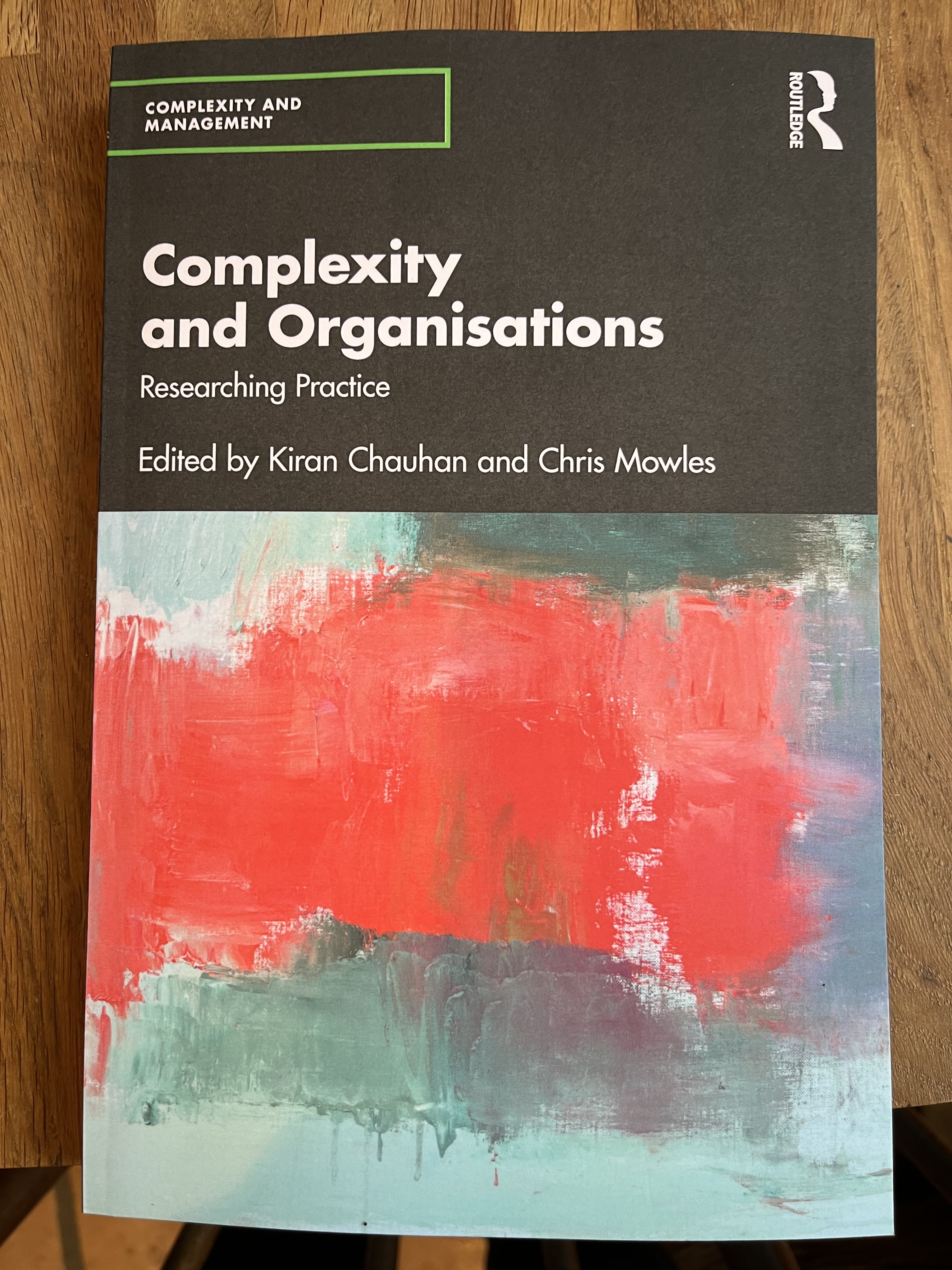
Complexity and Organisations: researching practice, the fourth volume in the Complexity and Management new series is published at the end of this month. Produced by the complexity research community at Hertfordshire Business School, the book explores how we can take complexity seriously as we inquire into our working worlds.
Drawing on their experiences as leaders, managers, researchers and educators, the contributing authors offer insights about exploring social life without trying to reduce or simplify it’s messiness and unpredictability. Addressing themes of history, culture and belonging, compromise, doubt, confidence and its lack, grief and loss, actors and non-human actors, ethics, values and politics, they provide accounts of taking experience seriously, of mobilising our capacity for reflexivity, with all its limitations, in pursuit of understanding more of what it is to be humans amongst humans trying to get stuff done together.
In doing so they make a number of assumptions about organisations and social life more generally.
At the core of organisational life are fluctuating relationships: I am because we are. There are limits to how much we can make the world in our own image, choose, predict and control as if we were autonomous, rational individuals.
We make organisations but organisations make us, a position which deflates the omnipotent assumption that managers and leaders can ‘create cultures’ of their choosing bend the future to their will. We are more influenced than influencing and paying attention to the push-pull of power relationships may give us greater insight into the qualities and limitations of our agency. We are all caught up in the game of organisational life, so how does the game affect us and our sense of belonging and identity; how are we affecting others?
If we are to illuminate how things became the way they are, it matters that we try and understand practical dilemmas in their history and context, and notice specific human bodies acting and speaking in particular ways. We are all shaped by broader social trends which play out differently in different organisations at different times. Management methods taught in business schools may be helpful in general, but we work with known others in the particular here and now. What can we say about the paradox of negotiating with particular others about general dilemmas that help us better understand the tasks we have before us?
Humans are both complex and flawed. Contemporary organisations acknowledge feeling to the extent that it can be harnessed for organisational ends. We are allowed to be passionate, positive and collaborative, but being political, rivalrous and critical are harder to take account of and speak about. Perhaps we can only be wiser about organisations if we can be wiser about ourselves, and our flawed human nature is the crack through which the light gets in. Our anxiety in the face of uncertainty, our need to belong and be recognised our competitive-cooperative impulses, all contribute to the flux and change of organisational life.
Suitable for the curious and the perplexed, whether you are consultants, pracademics, managers or leaders, this volume is a field guide for making better sense of everyday complexity.
Chapters by Drs Kiran Chauhan, Sune Bjørn Larsen, Sophie Wong, Karina Solsø Iversen, Mikkel Brahm, Helle Stoltz, Jannie Rasmussen, Tobit Emmens and Maj Karin Askeland.
The following is the text of the Ralph Stacey Memorial Lecture which I gave at Hertfordshire Business School on Weds 5th October 2022. It accompanies the video which you will find in the post below.
The response to the lecture was give by Patricia Shaw, who co-founded the Doctor of Management programme with Ralph and the late Doug Griffin.
Every once in a while, someone emerges with unique insight, who reframes the way we see the world. Ralph Stacey was such a person. He created a new vocabulary, and thus new ways of thinking and acting. Ralph developed a body of work, and founded a psychodynamic doctoral research programme, the Doctor of Management (DMan), with Doug Griffin and Patricia Shaw. At the heart of the perspective informing the intellectual position and DMan is taking experience seriously, and becoming reflexive. It remains a pioneering approach to combining insights from the complexity sciences, pragmatic philosophy, process sociology and group analytic theory, and it continues to evolve and develop.
In the Ralph Stacey Memorial Lecture, just over a year after his death and birthday, I will reflect on Ralph’s rich and varied life, his deep humanity and his intellectual contribution. Patricia Shaw will respond, offering insights into the continuing relevance of the ideas for the enduring dilemmas we find ourselves facing.
Outline programme:
4pm – 5.30pm – Experiential group. Face to face only.
6.00pm Ralph Stacey Memorial lecture by Chris Mowles, response by Patricia Shaw.
Q and A/observations.
7.45 Informal drinks and conversation.
The event will be live-streamed. Joining instructions will be sent out nearer the event.
In order for us to plan for numbers/send a link for streaming, RSVP c.mowles@herts.ac.uk
There are still some places remaining for the 2022 Complexity and Management conference. You can book here.
One of the things that delegates always remark upon about the CMC is how refreshing it is to get straight into conversations that matter. You can do this from the moment you arrive: on Friday 3rd June @7pm in the evening you get to meet other delegates for an inaugural dinner from all kinds of practice backgrounds and from all over Europe.
On Saturday morning we have the renowned practice scholar Prof Davide Nicolini @NicoliniDavide who will talk about the importance of a practice orientation in theory.
The afternoon is given over to delegates to talk about dilemmas in the workplace using each other as a resource to think further.
Early Saturday evening there will be a tree-planting ceremony to commemorate the life and work of the late Prof Ralph Stacey, who founded the Doctor of Management programme and the conference, and who loved Roffey Park.
There will be more more lively conversation accompanied by great food on Saturday night.
On Sunday morning we will respond to the key note and themes which have arisen during our discussions on Saturday.
Then there is one more round of reflection until lunch and close at 12.30 on Sunday.
When people sit together to talk about what’s going on, how they experience work, how they feel about their jobs, there may be some colleagues who complain that this is ‘just a luxury’. There is no time to sit around in a ‘talking shop’ when there is so much to do. And anyway, post-pandemic, haven’t we learnt that we can achieve just as much online?
If you are of the view that sitting around talking and thinking about how we are thinking and talking, what we find ourselves doing at work, then this year’s Complexity and Management Conference is probably not for you. As a broader research community we make an explicit assumption that one of a manager’s key tasks is to talk with their team about what they think is going on, what sense they make of it, and what it means for the group in taking the next steps together.
As a partial answer to the second point, why we are not running it online, we have organised this conference for the past two years online, and have benefitted from a broad range of participation from delegates who live too far away to come. From across time zones and sometimes great distances they have enriched the experience of paying attention to what we are doing. But it’s also the case that some qualities get lost. If we are concerned not just to talk about ideas, but to experience them, then occasionally there is no substitute for getting bodies together in a room. No more so when we choose to talk about the paradox of theory and practice. There is a practice in talking about theory, and the experience of doing so enhances learning in ways which are more than cognitive. We are moved into a different relationship with others and ourselves, a process which is attenuated online. Maybe everyone has recently experienced the difference of coming back to the workplace to work together in the same location as colleagues and has noticed the difference that encountering others makes. Having been out of practice, sometimes it may have felt overwhelming.
There is of course an environmental cost too to organising an in-person conference.
So, we have thought carefully about what we are doing and why, and we delighted to have Prof Davide Nicolini @NicoliniDavide to give us material to think about in his key note on Saturday morning 4th June. Thereafter the afternoon will be given over to anyone wanting to present their work or ideas in parallel workshops. On Sunday we respond to the previous day, and continue the discussion till lunchtime.
The conference fee includes all board and lodging. Roffey Park is set in a beautiful garden bordering a large meadow with a forest beyond. The food is of a high standard, the quality of conversation even higher and we would be delighted to see you there.
Here is the link to book. Early bird rates ends 30th April 2022.
At the heart of the community of inquiry developing the perspective of complex responsive processes of relating is the Doctor of Management (DMan) programme. It has been running for more than 20 years and to date has produced 75 doctoral graduates. In the pragmatic tradition we encourage students to take their every day experience seriously, and to think sociologically about how their daily travails are informed by, and inform broader socio-economic trends. They are encouraged to take the perspective of the pilot, and at the same time the perspective of the swimmer, caught up along with everyone else amid the swirling currents of every day organisational life. If the theses graduates produce have one thing in common, it is that they are all extended exercises in reflexivity. We encourage managers and consultants to think about how they are thinking and acting with others, and to bring their assumptions about the world more the fore. In doing so they are complexifying experience, but when they do so they are still obliged so say something of relevance and interest to colleagues working in similar domains. They produce knowledge from practice for practice.
If this video makes you interested in the DMan, the conference, or anything else, then please get in touch. The book is available here: https://amzn.to/3GIZYFj . Many thanks to David O’Dwyer for making this video.
My latest book, Complexity – a key idea for business and society, arises out of a community of inquiry, where a conversation about complexity and organising which has been going on for more than 20 years.
Contributing to the conversation are my faculty colleagues, Kiran Chauhan, Emma Crewe, Karen Norman, Nick Sarra and Karina Solsø, the students and graduates of the Doctor of Management (DMan) programme at the University of Hertfordshire, and the wider research community who attend the annual conference.
If this video makes you interested in the part time professional doctorate the DMan, which is run psychodynamically, the conference, which this year takes the theme of the theory and practice or anything else, then please get in touch.
How might we think about the politics of waiting – who waits the longest and for what? If organisations exist in a state of frenetic standstill, where we never catch up with ourselves before embarking on the next change, does ‘slow management’ help? What is involved in the decision to wait or to act, and in what ways is waiting also a form of action? What did periods of enforced lockdown, waiting for things to open up, enable and inhibit?
Complexity and Management Symposium Nov 20th 2021 – booking now.
If you are interested in spending the day discussing, reflecting and arguing with other colleagues, then the Complexity and Management Symposium offers an opportunity to explore the nexus of waiting and time. With a mixture of large group and small in the morning, and presentations on the theme of the complexity of waiting in the afternoon, the Symposium is booking now.
This year we held another highly participative conference to discuss the complexity of practice. In order to help us frame the day, we invited Prof Hari Tsoukas of Cyprus and Warwick Universities to give us his thoughts on complexity and practice, which you can watch below.
In the meantime, the Complexity and Management Conference is planning an online symposium for Saturday November 27th 2021, another date for your diaries.



 Complexity & Management Centre