Prof Carolyn Pedwell gave an overview of her book Revolutionary Routines at the Complexity and Management Conference, 2025. You can watch her presentation here: https://www.youtube.com/watch?v=niWTBSKABmM&t=12s
In her talk she covered a number of topics which privileged the every day, local and emergent interactions between humans, which is also the subject/object of our research community.
In response I re-presented some of the themes she covered from a complexity perspective, not as a form of critique, but as a way of bringing to light what it was I saw in her book when I first read it. I thought she would be a great speaker for our conference. Carolyn’s book and the perspective of perspectives we term complex responsive processes have family resemblances.
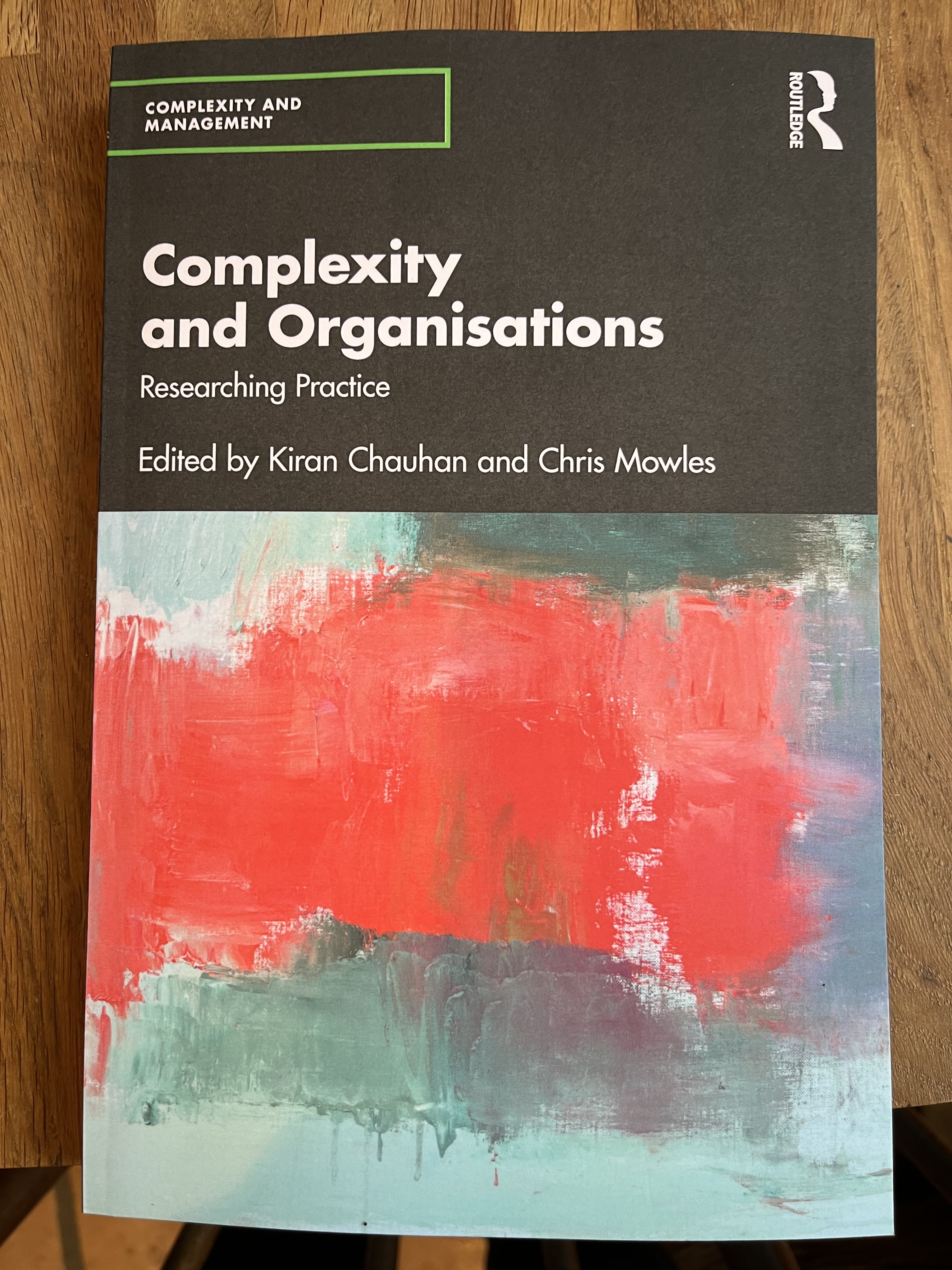
Complexity and Organisations: researching practice, the fourth volume in the Complexity and Management new series is published at the end of this month. Produced by the complexity research community at Hertfordshire Business School, the book explores how we can take complexity seriously as we inquire into our working worlds.
Drawing on their experiences as leaders, managers, researchers and educators, the contributing authors offer insights about exploring social life without trying to reduce or simplify it’s messiness and unpredictability. Addressing themes of history, culture and belonging, compromise, doubt, confidence and its lack, grief and loss, actors and non-human actors, ethics, values and politics, they provide accounts of taking experience seriously, of mobilising our capacity for reflexivity, with all its limitations, in pursuit of understanding more of what it is to be humans amongst humans trying to get stuff done together.
In doing so they make a number of assumptions about organisations and social life more generally.
At the core of organisational life are fluctuating relationships: I am because we are. There are limits to how much we can make the world in our own image, choose, predict and control as if we were autonomous, rational individuals.
We make organisations but organisations make us, a position which deflates the omnipotent assumption that managers and leaders can ‘create cultures’ of their choosing bend the future to their will. We are more influenced than influencing and paying attention to the push-pull of power relationships may give us greater insight into the qualities and limitations of our agency. We are all caught up in the game of organisational life, so how does the game affect us and our sense of belonging and identity; how are we affecting others?
If we are to illuminate how things became the way they are, it matters that we try and understand practical dilemmas in their history and context, and notice specific human bodies acting and speaking in particular ways. We are all shaped by broader social trends which play out differently in different organisations at different times. Management methods taught in business schools may be helpful in general, but we work with known others in the particular here and now. What can we say about the paradox of negotiating with particular others about general dilemmas that help us better understand the tasks we have before us?
Humans are both complex and flawed. Contemporary organisations acknowledge feeling to the extent that it can be harnessed for organisational ends. We are allowed to be passionate, positive and collaborative, but being political, rivalrous and critical are harder to take account of and speak about. Perhaps we can only be wiser about organisations if we can be wiser about ourselves, and our flawed human nature is the crack through which the light gets in. Our anxiety in the face of uncertainty, our need to belong and be recognised our competitive-cooperative impulses, all contribute to the flux and change of organisational life.
Suitable for the curious and the perplexed, whether you are consultants, pracademics, managers or leaders, this volume is a field guide for making better sense of everyday complexity.
Chapters by Drs Kiran Chauhan, Sune Bjørn Larsen, Sophie Wong, Karina Solsø Iversen, Mikkel Brahm, Helle Stoltz, Jannie Rasmussen, Tobit Emmens and Maj Karin Askeland.
Only three weeks to go before the end of the early bird discount for this year’s Complexity and Management conference. You can book here.
The theme for this year’s conference is Complexity and Culture.
We are delighted to welcome Dr Patricia Shaw, who will be familiar to many of you. She will give the key note in conversation with Prof Nick Sarra.
The Complexity and Management Conference is an antidote to the sense of drift and thoughtlessness which can afflict managers in organisations because of the sheer complexity and pace of work, and the abstractions of contemporary management discourse. The currency of the conference is conversation, reflection and meaning-making about things that matter to us in and beyond the workplace.
Saturday afternoon will be given over to delegate-led workshops to explore the conference theme.
Sunday morning will be a chance for Prof Karen Norman and I to reflect together on some of the themes of the conference to offer a further reflexive turn in thinking.
The annual Complexity and Management Conference, held this year between 7th-9th June 2024 at Roffey Park in Horsham, UK, is intended as an opportunity to make sense of the rationally irrational processes that we get caught up in at work. The currency of the conference is conversation, reflection and meaning-making about things that matter to us in the workplace and beyond.
The topic for this year is culture which is often considered to be thing-like, and capable of manipulation by leaders and managers to create the outcomes we think we want. These are often ideals of high performance, collaboration and positivity.
However, whatever we think of as culture, the habituated pattern of behaviour which allows us to recognise each other as we co-operate and compete, is not so easily subjected to our plans and intentions. We are as much shaped by the habitus as we can shape it.
This year we are delighted to invite Professor Candida Yates to help us explore this theme . She will talk about a current research project where she is trying to understand how the community imaginary is developed and sustained. Drawing on work she is undertaking with a community on the south coast of the UK, Professor Yates will give examples of art-based and psycho-social approaches to exploring to the emergence of meaning in a UK maritime community through the exploration of thoughts, feelings, politics and experience.
Candida Yates is Professor of Culture and Communication, Bournemouth University. She is an interdisciplinary scholar and applies a psychosocial approach to culture, politics and society and has published widely in that field. She works with academics, clinicians, creatives and cultural organisations to create new understandings of emotion and affect in the public sphere. She is a Co-Director of the BU Centre for the Study of Conflict, Emotion and Social Justice and sits on the Executive Boards of the Association for Psychosocial Studies; is a Founding Scholar of the British Psychoanalytic Council and is an Academic Research Associate of the Freud Museum. She is Joint-Editor of the Routledge book series: Psychoanalysis and Popular Culture, andis a Contributing Editor on the journals Psychoanalysis, Culture and Society, and The Journal ofPsychosocial Studies.
The conference starts with an inaugural supper on the evening of Friday June 7th and will finish after lunchtime on the 9th June. The conference fee includes all board and lodging at Roffey Park Insitute, which is a residential setting.
There will also be an introductory day on complexity and organisation and the unique perspective of complex responsive processes on Friday 7th.
The booking page will go up on the University of Hertfordshire website at the end of this month.
For any queries contact me on c.mowles@herts.ac.uk
Complexity, uncertainty, breakdown: coping, recovering and finding hope in dark times.
With the world in flux, perhaps it’s time to be less naïve about the idea of disruption. Our recent experience tells us that we have struggled to respond to disruptive socio-economic and political forces, let alone harness them for the good. Instead constant upheaval on the grand scale, the banking crisis, the pandemic, political and economic instability, has permeated society and our psyches, and has shown up inevitably in our practices and relationships in everyday organisational life. The effects of political and social turmoil, economic collapse, have set constraints on what we can achieve together in organisations. And they may have produced acute and enduring work place dilemmas which can provoke anxiety, burn-out and a sense of hopelessness. Constant disruption demands a more creative and subtle approach than may be found in orthodox recipes for leading, managing and consulting, or an idealisation of its benefits. Equally, we are required to find more generative responses than those offered by the lords of misrule who come to prominence in dark times recommending simplistic solutions to complex problems.
It is also worth thinking about the possible benefits of the huge disruption to traditional working practices caused by what the Oxford English dictionary now recognises as a neologism: the permacrisis. No profound set of social and economic changes is an unalloyed disaster. Where are the loci of hope?
The Complexity and Management Conference 2023 will address what can feel like a constant state of breakdown, potentially undermining things we may previously have taken for granted, such as plans, rules, loyalties, markets, knowledge, and how we exercise authority in groups.
The conference will be organised around contributors to the recent Complexity and Management series published by Routledge, which include the titles Complexity and Consultancy, Complexity and Leadership and Complexity and the Public Sector. Contributors will talk about their experience of leading, managing and consulting to a wide range of organisations, particularly the public sector. An invitation is also extended to all delegates attending the conference who want to offer a workshop on Saturday afternoon 3rd June.
If you are interested in the difference it makes to take the complex interplay of relationships seriously, particularly in dark times, then book for the 2023 Complexity and Management Conference, 2nd-4th June. The conference is highly discussive and conversation is the currency of participation. It will greatly enhance the conference if delegates bring concrete examples of their workplace dilemmas.
The conference is organised in collaboration with KIOL Executive Programme at University College Copenhagen.
The following is the text of the Ralph Stacey Memorial Lecture which I gave at Hertfordshire Business School on Weds 5th October 2022. It accompanies the video which you will find in the post below.
The response to the lecture was give by Patricia Shaw, who co-founded the Doctor of Management programme with Ralph and the late Doug Griffin.
This is to give advance notice of The Ralph Stacey Memorial Lecture on Weds 5th October at the University of Hertfordshire, 6pm. The day we have chosen is close both to his birthday and to the date of his death.
I will give a tribute to Ralph and his legacy and Patricia Shaw has agreed to give a response. We hope to turn the lecture into an annual event.
The lecture will be held at the Business School, de Havilland campus, where Ralph was an employee for 32 years. It will be live-streamed so that people can join remotely. For those interested and present in person, we may follow the lecture with an experiential group.
If you’re interested in attending/viewing then please save the date. Further details will follow.
In addition, the dates of next year’s conference are 2nd-4th June 2023. I am assured that there are no further Jubilee celebrations that weekend.
There are still some places remaining for the 2022 Complexity and Management conference. You can book here.
One of the things that delegates always remark upon about the CMC is how refreshing it is to get straight into conversations that matter. You can do this from the moment you arrive: on Friday 3rd June @7pm in the evening you get to meet other delegates for an inaugural dinner from all kinds of practice backgrounds and from all over Europe.
On Saturday morning we have the renowned practice scholar Prof Davide Nicolini @NicoliniDavide who will talk about the importance of a practice orientation in theory.
The afternoon is given over to delegates to talk about dilemmas in the workplace using each other as a resource to think further.
Early Saturday evening there will be a tree-planting ceremony to commemorate the life and work of the late Prof Ralph Stacey, who founded the Doctor of Management programme and the conference, and who loved Roffey Park.
There will be more more lively conversation accompanied by great food on Saturday night.
On Sunday morning we will respond to the key note and themes which have arisen during our discussions on Saturday.
Then there is one more round of reflection until lunch and close at 12.30 on Sunday.
When we talk about the theory of practice and the practice of theory, does this mean that the conference is going to be very dry and abstract? The focus of the research community which organises the annual Complexity and Management Conference is on human beings and the complex dynamics they get caught up in when they try and get things done with other people. So we are interested in what we say and do, what we think we mean when we say particular things, how trying to go on together sometimes brings about the opposite of what we intend, and how our identities are changed in the process. We are concerned with reflecting on, and becoming reflexive about everyday organisational dilemmas.
The conference begins with a gala dinner on Friday 3rd June @7pm and welcome drinks.
The mode of the whole conference is conversational. This year we are delighted to have engaged Prof Davide Nicolini of Warwick Business School to give the key note because of his insightful work on the importance of practical knowledge.
There is an opportunity for delegates to present their ideas too, on Saturday afternoon 4th June. This might be a paper or a chapter in a book, or it might be something troubling at work which presenters want to use a group as a resource to think about.
On Sunday we reflect on what we have been talking about on Saturday with the help of faculty members from the Doctor of Management programme. Thereafter we have one more round of reflection in groups and finish off with lunch.
It’s exhausting but invigorating at the same time. Hope to see you there. Book here.



 Complexity & Management Centre